


The Montana House voted decisively Monday evening to kill one of Gov. Greg Gianforte’s key housing affordability proposals, a bill that would have allocated $200 million toward infrastructure to help build new homes in an effort to ease the state’s housing crunch.
The bipartisan 30-69 vote on the Home Ownership Means Economic Security, or HOMES Act, spells a potential death knell for the only part of the Republican governor’s policy agenda that sought to make housing accessible to more Montanans by investing state dollars, as opposed to boosting supply by easing restrictions on new development.

The proposal, House Bill 825, could be amended into other legislation in late-session negotiations, and the House has advanced other measures that would put state dollars toward housing.
The bill was generally supported by moderate Republicans and attracted votes from a few minority-party Democrats. However, it lost majorities of both caucuses, with nos from 45 of 68 House Republicans and 24 of 32 Democrats.
Gianforte press secretary Kaitlin Price said in a statement Monday evening that the governor’s office is “disappointed” by the vote.
“Governor Gianforte has heard from Montanans across our state, and he shares their priority of increasing access to affordable workforce housing,” Price wrote. “The governor will continue to work with legislators to address the housing shortage and get the HOMES program across the finish line.”
The bill would have invested the $200 million in a trust fund, using earned interest to fund housing efforts on an ongoing basis. An eighth of the money would have been used to cover administrative costs and provide planning grants to local governments looking at ways to increase their housing supply.
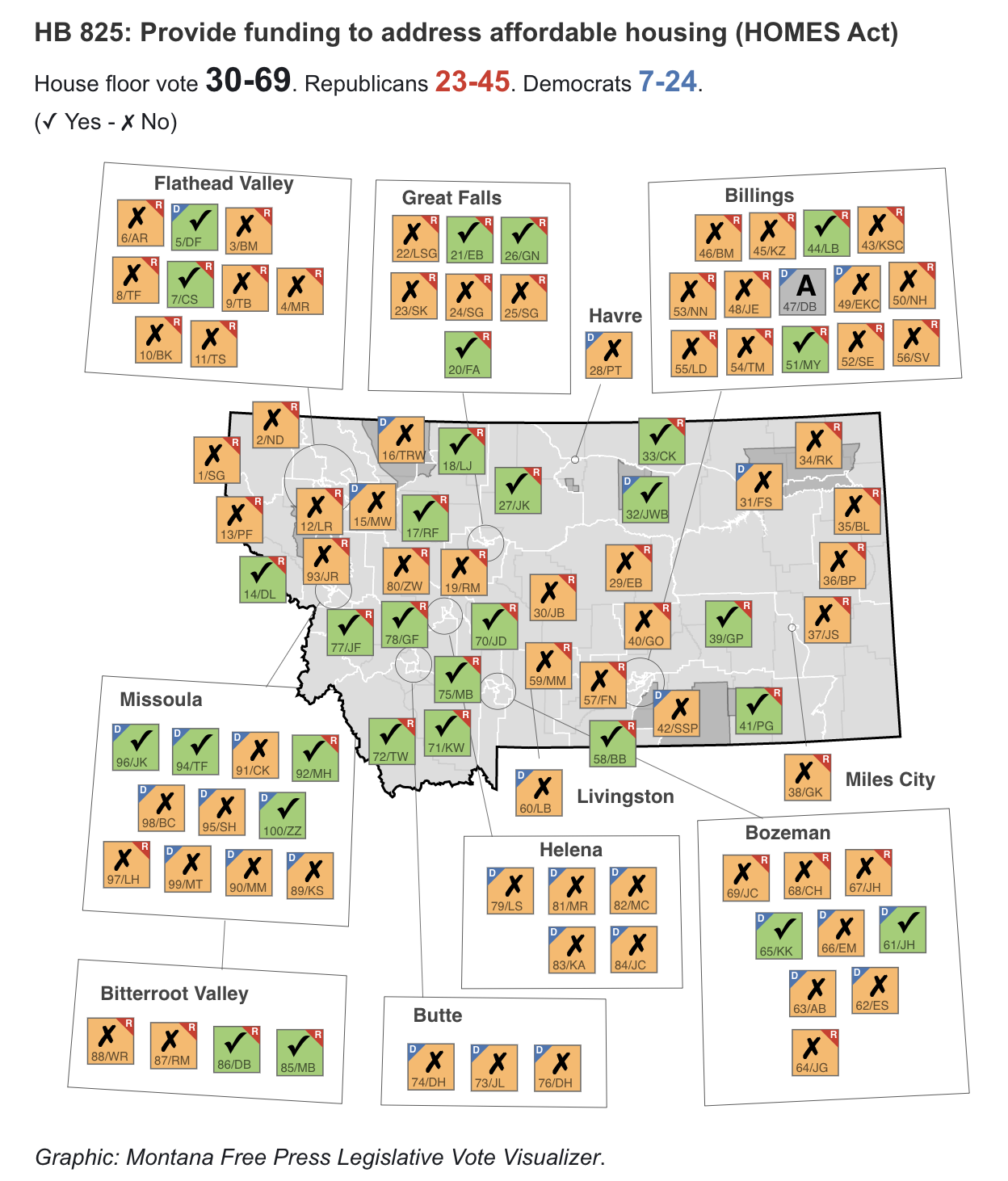
The remainder would be used to offer loans to help pay for the construction of water lines, sewer lines, streets, sidewalks and other infrastructure necessary to serve new housing developments, with the idea that new construction encouraged by the program would bring down the cost of housing broadly by making it harder for landlords and home-sellers to command high prices.
Sponsor Mike Hopkins, R-Missoula, argued the bill would complement efforts that promote new home construction by reining in existing zoning laws. He also said the proposed program was structured in a way that would draw matching dollars from the development industry.
Bill opponents cited various objections during Monday’s floor debate.
Rep. Tanner Smith, R-Lakeside, for example, said he is skeptical that it’s a good time to invest public dollars in housing construction, given currently high construction costs.
“There’s so much money out there in the private sector that’s just waiting for the cost of goods to go down,” Smith said.
Rep. Bill Mercer, R-Billings, said he was frustrated that proponents couldn’t answer questions about how much the state’s investment would bring down the price of the resulting homes, or whether Montana’s busy construction industry has the capacity to take on work produced through the program.

“I’m really not sure what this would deliver in the short-term or the long-term,” Mercer said.
Speaker of the House Matt Regier, R-Kalispell, also opposed the bill, saying he is concerned the money would end up going to big out-of-state developers who are already building homes in places like the Flathead.
On the Democratic side of the aisle, House Minority Leader Kim Abbott, D-Helena, said she was concerned the bill didn’t do enough to make sure it produces homes that would be priced affordably.
“Nothing in this bill ensures attainable housing for people,” Abbott said.
Regier and Abbot have co-sponsored competing housing legislation, House Bill 927, which would transfer $115 million to the state coal trust fund to support loans for housing projects that make price-controlled units available for lower-income residents. That bill passed an initial floor vote 82-18 Wednesday.
The House also endorsed House Bill 819, which would put $50 million toward a program intended to help middle-income residents purchase homes. Sponsored by Rep. Paul Green, R-Hardin, HB 819 passed its initial floor vote 67-32.
If HB 927 and 819 pass final votes in the House Tuesday, they’ll advance for further debate — and potential amendment — in the Senate.

This story is published by Montana Free Press as part of the Long Streets Project, which explores Montana’s economy with in-depth reporting. This work is supported in part by a grant from the Greater Montana Foundation, which encourages communication on issues, trends, and values of importance to Montanans. Discuss MTFP’s Long Streets work with Lead Reporter Eric Dietrich at [email protected].
latest stories
Two PSC districts on Montana ballot: Meet the candidates
Two Montana Public Service Commission seats are up for election this year. Candidates running to serve on the PSC would be tasked with regulating monopolies, like utility companies, including new emerging sectors such as power for data centers.
It’s undebatable: Flint-Forstag is Montana’s hottest race
PLUS: Truth in advertising? You be the judge.
Could Montana suspend its fuel tax?
Diesel prices have spiked since March, a result of the U.S. conflict in the Middle East and the ongoing war between Ukraine and Russia. The increased cost has strained Montana farmers, ranchers and truckers. What can state officials do, if anything, to help ease those economic pressures? One Montana Free Press reader reached out to…
