

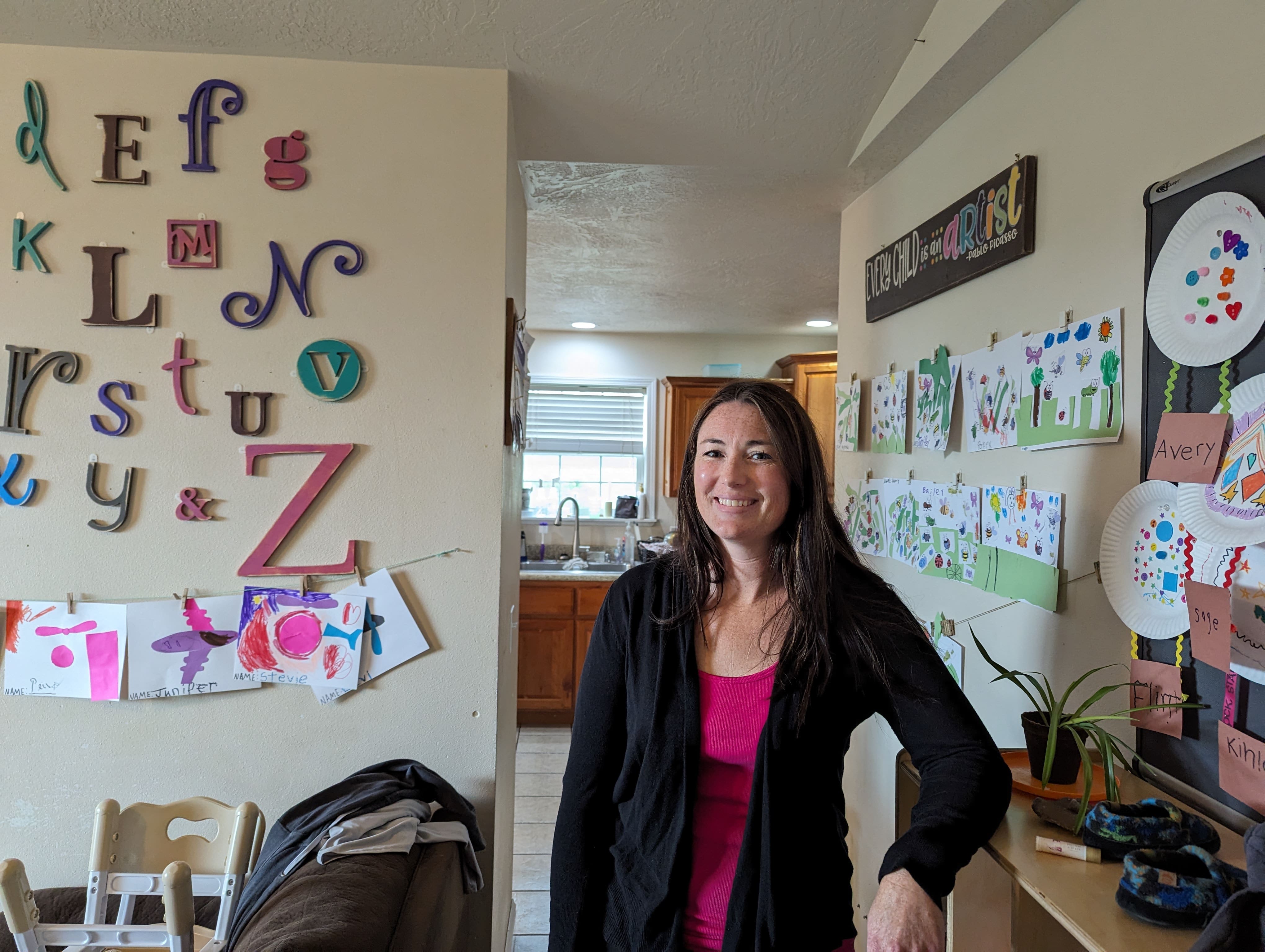
Montana Free Press recently investigated the challenges facing working families and childcare providers in Montana, in collaboration with the national news nonprofit Open Campus. The following portrait provides a deeper view into the experience of one of the sources crucial to that reporting, offering readers another lens through which to understand how childcare issues are impacting everyday Montanans.
Becca Brush’s living room on the westernmost outskirts of Missoula is full of kinetic energy. Small feet race across the carpet, small hands cling to children’s instruments and toys, small mouths giggle and shout. The morning antics of more than a dozen kids are corralled by a set of low wooden shelves separating the wide room from the open front hall.
Brush got her start as a childcare provider in Frenchtown at age 19 and quickly worked her way up to the head of her own home-based business. Her Beautiful Beginnings group childcare currently enrolls 20 children from the Frenchtown area and employs two staff in addition to Brush. Weekdays here involve singalongs, picture-sorting games and themed art projects. The walls are decked with vibrantly colored paper cutouts of dinosaurs one month, and flowered self-portraits in the style of Frida Kahlo the next. The pockets of Brush’s sweater are occasionally crammed with children’s socks.
Since her earliest years in the childcare profession, Brush has strived to create a sense of community with and among the parents she serves. She sees herself not just as a caretaker and educator but as part of a broader support network for early childhood development. Yes, readying kids under age 5 for the academic rigors of public school is part of the Beautiful Beginnings equation, she said. But connecting with families and helping them promote strong social-emotional skills among children remain her top priorities.
related

Montana’s stubborn childcare conundrum
Barriers to childcare kept an estimated 66,000 Montanans from fully engaging in the workforce in 2023, training a local lens on a national crisis that families, providers, and higher education programs are struggling to navigate. Over the past three months, MTFP collaborated with Open Campus, a higher education news outlet that works in partnership with local newsrooms, to explore those challenges through the lives of everyday Montanans trying to make it work.
“My biggest thing is just having good relationships with the parents, and ever since I opened that’s always been my main focus, no matter what,” Brush said. “I just know that learning’s going to be a lot harder if they can’t communicate what they want [and] how they feel to their peers, to us, to their parents.”
As dedicated to her work as Brush is, after 18 years she’s now looking for a change. She recently earned her associate degree in early childhood education remotely from the University of Montana-Western in Dillon, and is on track to earn her bachelor’s degree in fall 2026. Her end goal? To transition into teaching in the local K-12 school system.
One of the primary drivers of Brush’s gradual professional evolution is literally written on the walls of her Missoula-area home. Save for one outdated family portrait, the entire first floor is decorated exclusively with ornaments of the childcare field: children’s drawings, dinosaur stickers, wooden cutouts of alphabet letters. Her kitchen table is just over a foot high, perfect for the 3- and 4-year-olds who spend their weekdays here — but, she said, not ideal for her 6-foot-2-inch stepson during family dinners. In other words, there’s little separation for Brush between her work life and her personal life.
Her career evolution’s top motivation, though, is financial. According to the Montana Department of Public Health and Human Services, the average total income for group-based providers like Beautiful Beginnings was $142,486 last year, while annual expenses averaged $145,695. The industry operates on thin margins, and Brush said her business can’t afford to provide health insurance or retirement for her or her employees — benefits that are making a transition into elementary school education, where those benefits are available, particularly appealing.
“I love my job, I love working with these ages, and I’m not leaving to get out of it,” Brush said. “But if you’re a provider, you don’t get health insurance through work, you don’t get a 401K, and you’re the last to get paid after you pay everyone else.”
latest stories
‘Where they belong’: Fort Peck Assiniboine and Sioux Tribes bring home the remains of three members
In early September, a van leading a caravan home stopped on Big Muddy Creek Bridge, marking the boundary of the Fort Peck reservation. Families embraced, tears were shed, and the smell of burning sage lingered. In the back were three wooden caskets draped in the flags of the Assiniboine and Sioux. Over the following days, community members celebrated, processed and grieved the repatriation of three long-separated members who died at the Carlisle Indian Industrial School. As one former tribal official put it: “They are home where they belong.”
Federal judge blocks Montana’s AI campaign ad law
A Montana law regulating the use of generative artificial intelligence in campaign ads has been dealt a blow by a federal judge based on freedom of speech concerns. The order greenlights general election advertising that former legislator Dan Bartel and ASG PAC planned to use, but feared being prosecuted for.
Montanans are using AI, but remain wary of its societal impact
Almost four years after OpenAI’s release of ChatGPT, AI is now firmly rooted in many Montanans’ day-to-day tasks, according to a Montana Free Press-Eagleton poll of registered voters conducted in late August and early September. More Montanans use AI — and to some extent trust AI — for general searches, work tasks and writing, than for more intimate functions, like medical advice or companionship. Users remain skeptical of the technology’s broader impacts, too. Only about 12% believe AI has a “somewhat” or “very positive” impact on society.
