


A year after 10 Montana Rail link railcars plummeted into the Yellowstone near Reed Point, sending nearly 412,000 pounds of molten asphalt into the river, federal authorities have yet to release their findings on the cause of the crash.
The Federal Railroad Administration told Montana Free Press that the crash, which occurred on June 24, 2023, is still under investigation. FRA spokesperson William Wong did not provide a timeline for the release of its report but did say the agency is in the final phase of its investigation.
A report Montana Rail Link provided to the FRA in the weeks after the accident says only that a portion of its train derailed while crossing a bridge over the Yellowstone. Sixteen of the 35 rail cars carrying hazardous materials derailed or were damaged in the incident.
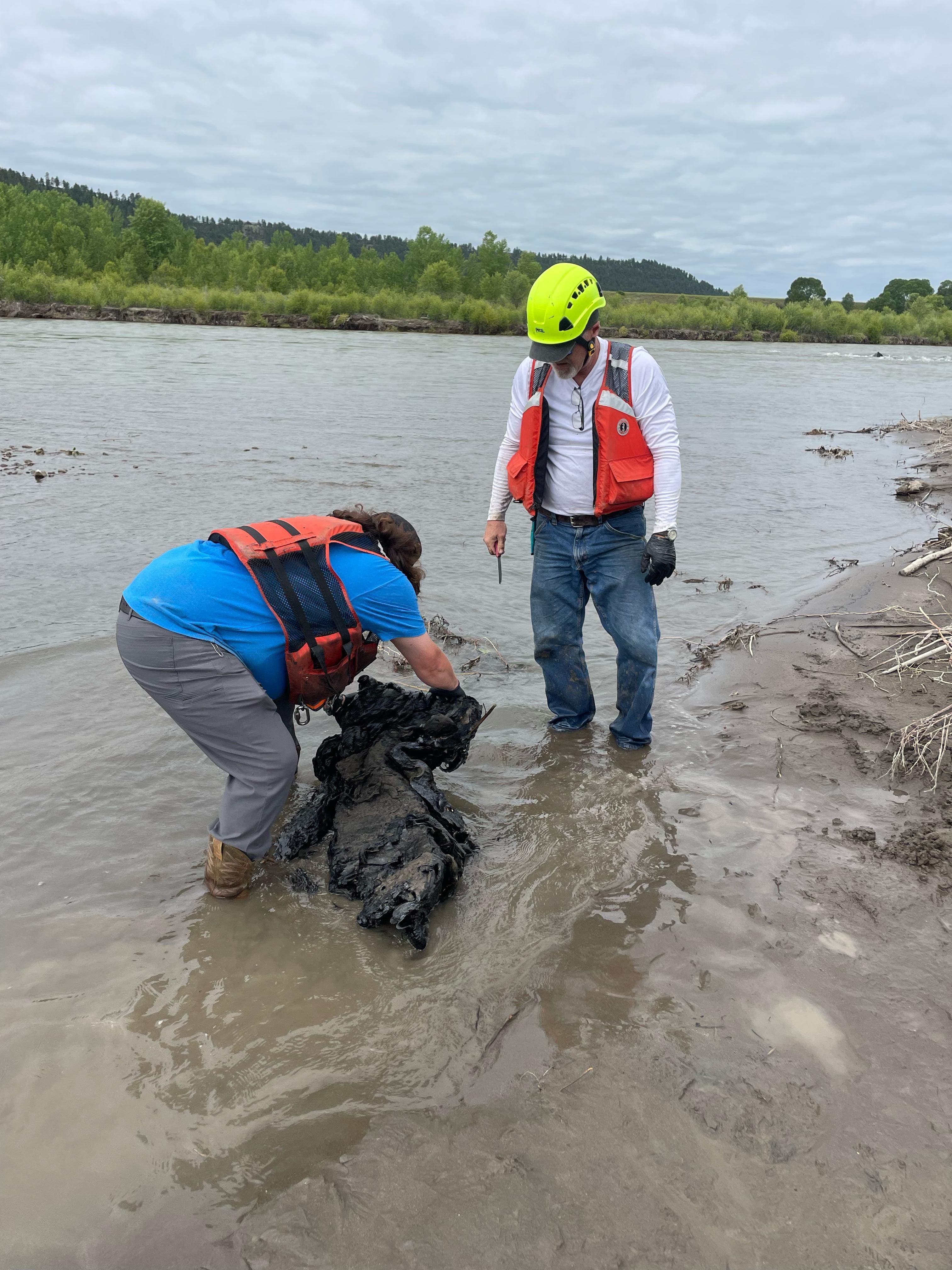
The cars that fell into the river contained molten sulfur, scrap metal and molten asphalt, or crude oil mixed with gravel or sand. The asphalt was the primary area of concern for downstream water users and the focus of a multi-month clean-up effort that recovered about 236,000 pounds of asphalt. The clean-up effort is ongoing but has slowed considerably as less “actionable asphalt” remains along the river’s banks.
In September, the state of Montana advised anglers not to eat fish caught in a 48-mile section of the Yellowstone River downstream of Reed Point due to elevated levels of polycyclic aromatic hydrocarbons (PAH), which are found in oil, gas, plastics and pesticides and can occur naturally in the environment, particularly in the shale rock that’s common in the Yellowstone River basin.
On May 31, the Fish Consumption Advisory Board lifted its September advisory but urged women of reproductive age and children younger than 6 not to eat sucker fish (a species not commonly consumed by humans) caught between Laurel and the Yellowstone’s confluence with the Bighorn River due to elevated levels of petroleum hydrocarbons in collected samples. The board consists of representatives from the Montana Department of Public Health and Human Services, the Montana Department of Environmental Quality and Montana Fish, Wildlife and Parks.
During a meeting in Columbus on Feb. 29, Mike Ruggles, regional supervisor with FWP, said the department had compared recovered asphalt with the PAH found in the fish tissue sampled, and the “fingerprints” between the two didn’t quite align, making it difficult to determine if the elevated levels were tied to the derailment. He said that at that time there was “no direct link to the derailment and that material.”
In an email to Montana Free press, DEQ spokesperson Rebecca Harbage said fish sampling between a fishing access site near the derailment and Worden is ongoing. Results, which will be reviewed by the board, are anticipated in late August.
RELATED

Cleanup begins after freight train derails into Yellowstone River
Montana Rail Link has begun cleaning up a derailment that occurred Saturday morning on a bridge near Reed Point, southeast of Big Timber, sending rail cars loaded with molten sulfur and asphalt into the Yellowstone River. The derailment occurred at approximately 6:45 a.m. Saturday, when a westbound train traveling from Laurel to Missoula derailed while crossing the river. Nobody was injured in the wreck. The cause of the derailment is under investigation, and it’s currently unclear whether a bridge collapse caused the derailment, or a derailment caused the bridge to collapse.

Officials estimate 500,000 pounds of tar-like asphalt could have entered the Yellowstone in railway incident
Officials estimate as much as 500,000 pounds of molten asphalt entered the Yellowstone River as a result of a bridge collapse and train derailment that led to 10 Montana Rail Link rail cars plunging into one of the state’s largest rivers.

State advises anglers not to eat fish caught in 48-mile stretch of Yellowstone River
Nearly three months after a Montana Rail Link train derailed near Reed Point, releasing 419,000 pounds of asphalt into the Yellowstone River, state agencies began advising anglers this week not to eat any fish caught on a nearly 50-mile stretch of the river.
Harbage said DEQ does not have baseline data on PAH in Yellowstone fish — information that could help establish whether elevated levels are linked to the 2023 derailment. That’s due in part to the cost of sampling for PAH, which Harbage said is typically reserved for targeted areas with known potential sources.
Petroleum hydrocarbons can include a complex mix of chemicals, some of which can negatively affect the immune system, lungs, liver and kidneys. FWP reported in May that the types of hydrocarbons detected in the fish samples in September are not listed as carcinogens or likely carcinogens by the EPA and the International Agency for Research on Cancer.
A fine for the derailment has not been levied, in part because the response is ongoing. Both DEQ and the U.S. Environmental Protection Agency have a role in enforcement, and the Natural Resource Damage Program, a 34-year-old program that’s exercised some oversight in the environmental mitigation of a 2016 pipeline rupture that spilled oil into the Yellowstone River near Laurel. NRDP is expected to levy a fine that will be used to rectify damages that occurred as a result of the derailment.
“DEQ chose to wait for the emergency response phase to wrap up to ensure we are aware of all impacts before deciding on the precise violations and moving forward with enforcement action,” Harbage told MTFP.
MTFP’s request to Burlington Northern Santa Fe, which took control of Montana Rail Link in January, about the money it’s spent on the derailment response was not returned Thursday.
According to a tally the EPA released on Feb. 29, eight snakes and 11 birds died from exposure to the asphalt released in the spill.
LATEST STORIES
Montana drops bison lawsuit against Yellowstone National Park
Motion to dismiss ends nearly two years of litigation, renewed tension over who gets a say in bison management
Poll: Rep. Troy Downing ahead in Eastern U.S. House District
A Montana Free Press-Eagleton poll conducted between Aug. 27 and Sept. 7 shows incumbent Rep. Troy Downing with a substantial lead over Democrat Brian Miller in their race for Montana’s Eastern District U.S. House seat.
What Missoula’s homelessness response looks like one year after Johnson Street shelter closure
The last 12 months without the 165-bed emergency shelter have left Missoula’s longstanding homeless shelter full more often than not and have strained other organizations serving people living on the street. Limited shelter capacity also means more people are living outside to navigate the city’s camping restrictions, providers said.
