


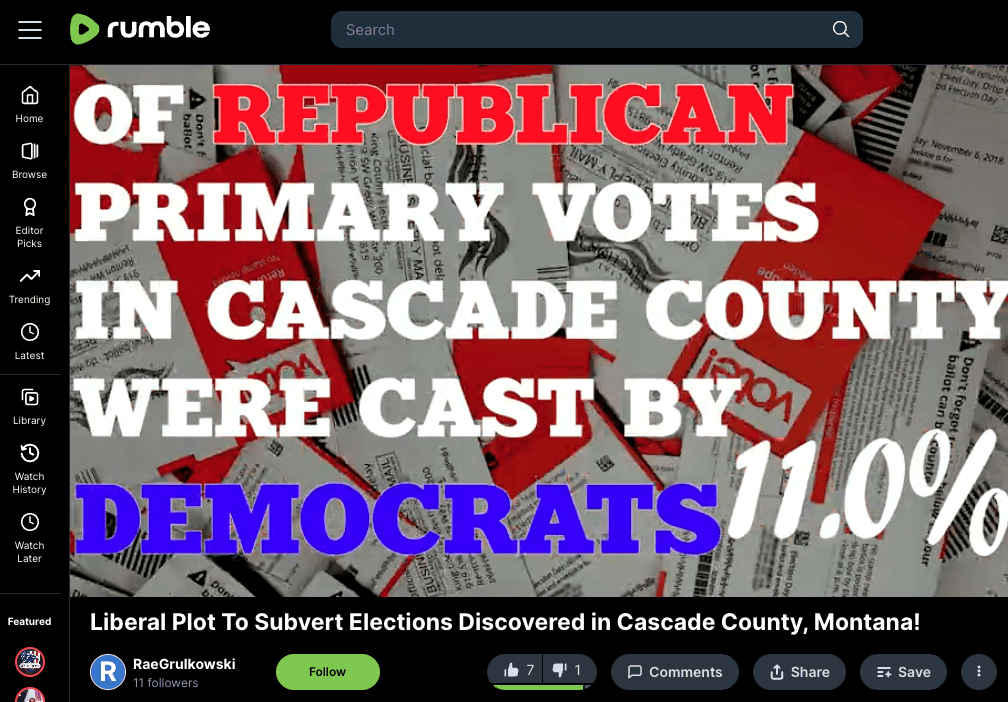
Last month, Cascade County Commissioner Rae Grulkowski posted a video to social media claiming that 11% of votes in her Republican primary race were cast by Democrats. The video went on to say this was part of a national effort to “infiltrate the Republican Party.”
In subsequent interviews, Grulkowski backed away from the specifics of the claim, though she stood by her broader assertion.
Grulkowski told Montana Free Press that she reached the 11% figure by assuming that all of the 1,309 voters who entered “no preference” on Republican ballots for the presidential race also voted for her primary opponent, Eric Hinebauch, in the county commissioner primary.
Hinebauch won in the June Republican primary with 57% of the vote. Grulkowski has registered as a write-in candidate for the November general election.
In Montana primaries, everyone gets the same ballots, regardless of party affiliation, and voters choose which party’s ballot to fill out and submit. There isn’t a direct way to calculate how many voters might have been Democrats. It’s also difficult to track whether each “no preference” voter on the presidential line also filled in the bubble for the commissioner race without reviewing each individual ballot.
When pressed, Grulkowski softened her stance on the 11% claim.
“Likely not Republican,” she said of the voters. “So you can’t say with absolute surety… It’s just looking at those numbers, and the big assumption is that they were not Republican.”
Grulkowski was correct that there was an effort in Cascade County to get Democrats to vote against her. There were few contested primaries for Democrats to participate, and no local or legislative Democratic candidate faced a primary challenger. Great Falls activist Jasmine Taylor saw this as an opportunity. She took to social media to urge fellow Democrats to vote for Hinebauch. She also took aim at other Republicans whom she viewed as “extremists,” including legislative candidates Steven Galloway and Lola Sheldon-Galloway, both of whom lost contested primaries.
Taylor told MTFP that the tactic appeared to work after Grulkowski lost the primary race, but she didn’t think 1,300 fellow Democrats participated.
“That’s astronomically high,” she said. “I would love to say that we had an 11% crossover, but that’s not realistic.”
Taylor, whose TikTok posts were featured in Grulkowski’s Rumble video, said she was acting independently. Cascade County Democrats Chair Helena Lovick said Taylor’s effort didn’t involve the local party.
“There absolutely was not a Cascade County Democratic Party action to oust Rae Grulkowski during that primary,” Lovick said. “We of course were aware of it.”
Lovick also felt that 11% of the vote being cast by Democrats seemed “extraordinarily high.”
Hinebauch doesn’t think 11% is accurate, either. He was aware of Taylor’s effort to get Democrats to submit Republican primary ballots but said that his margin of victory made it a non-factor.
“I’m not denying it was there and it helped my overall total,” Hinebauch said. “But I believe I beat her straight up with Republican voters.”
Hinebauch won the primary by 1,775 votes — a margin of 14 percentage points.
Hinebauch and Grulkowski now face another showdown for the general election. Both have name recognition in the county. Hinebauch is a former city commissioner and chair of the Cascade County Republican Central Committee. Grulkowski is the current county commissioner who gained supporters and detractors in several high-profile skirmishes over county elections management.
Most recently, Grulkowski was the lone vote against a discrimination settlement to former Clerk and Recorder Rina Fontana Moore, who filed a complaint over the decision to hire Terry Thompson as elections administrator over her.
The question going forward is how much Grulkowski’s write-in campaign will split the Republican ticket and give Don Ryan, the Democratic candidate, an advantage.
“I think it’s pretty clear that it actually appears to possibly help Don Ryan’s reelection campaign,” Lovick said. “We obviously support our candidate Don Ryan and think he’s the best potential commissioner in this race.”
Ryan told MTFP that he didn’t love the idea of crossover votes, but he believed that it happened because there were few competitive Democratic primaries in Cascade County.
“She may have a legitimate point that it happened, but when you take a look at the number of Republicans who voted against her, it wasn’t Democrats who put her out,” he said.
Ryan said he respects Grulkowski’s right to campaign as a write-in candidate, but he’s concerned about how a large number of write-in ballots will affect the speed of vote tallying on Election Day. That speed would be greatly slowed if candidates use stickers for write-in names, which was recently banned by the county elections office.
Ballots with stickers would be fully hand-counted, top to bottom, in an election with many high-profile races. In addition to taking more time, hand counting has been shown to produce more errors than machine counts.
“If you get, for example, 1,000 or 1,200 people who choose to use stickers, that’s a lot of ballots to count,” Ryan said.
In-depth, independent reporting on the stories impacting your community from reporters who know your town.
LATEST STORIES
Federal judge blocks Montana’s AI campaign ad law
A Montana law regulating the use of generative artificial intelligence in campaign ads has been dealt a blow by a federal judge based on freedom of speech concerns. The order greenlights general election advertising that former legislator Dan Bartel and ASG PAC planned to use, but feared being prosecuted for.
Montanans are using AI, but remain wary of its societal impact
Almost four years after OpenAI’s release of ChatGPT, AI is now firmly rooted in many Montanans’ day-to-day tasks, according to a Montana Free Press-Eagleton poll of registered voters conducted in late August and early September. More Montanans use AI — and to some extent trust AI — for general searches, work tasks and writing, than for more intimate functions, like medical advice or companionship. Users remain skeptical of the technology’s broader impacts, too. Only about 12% believe AI has a “somewhat” or “very positive” impact on society.
Initiative banning corporate money in elections gets a spotlight in Billings
Supporters of a ballot initiative to ban corporate spending in Montana elections hosted a Q-and-A at the Alberta Bair Theater in downtown Billings.
