

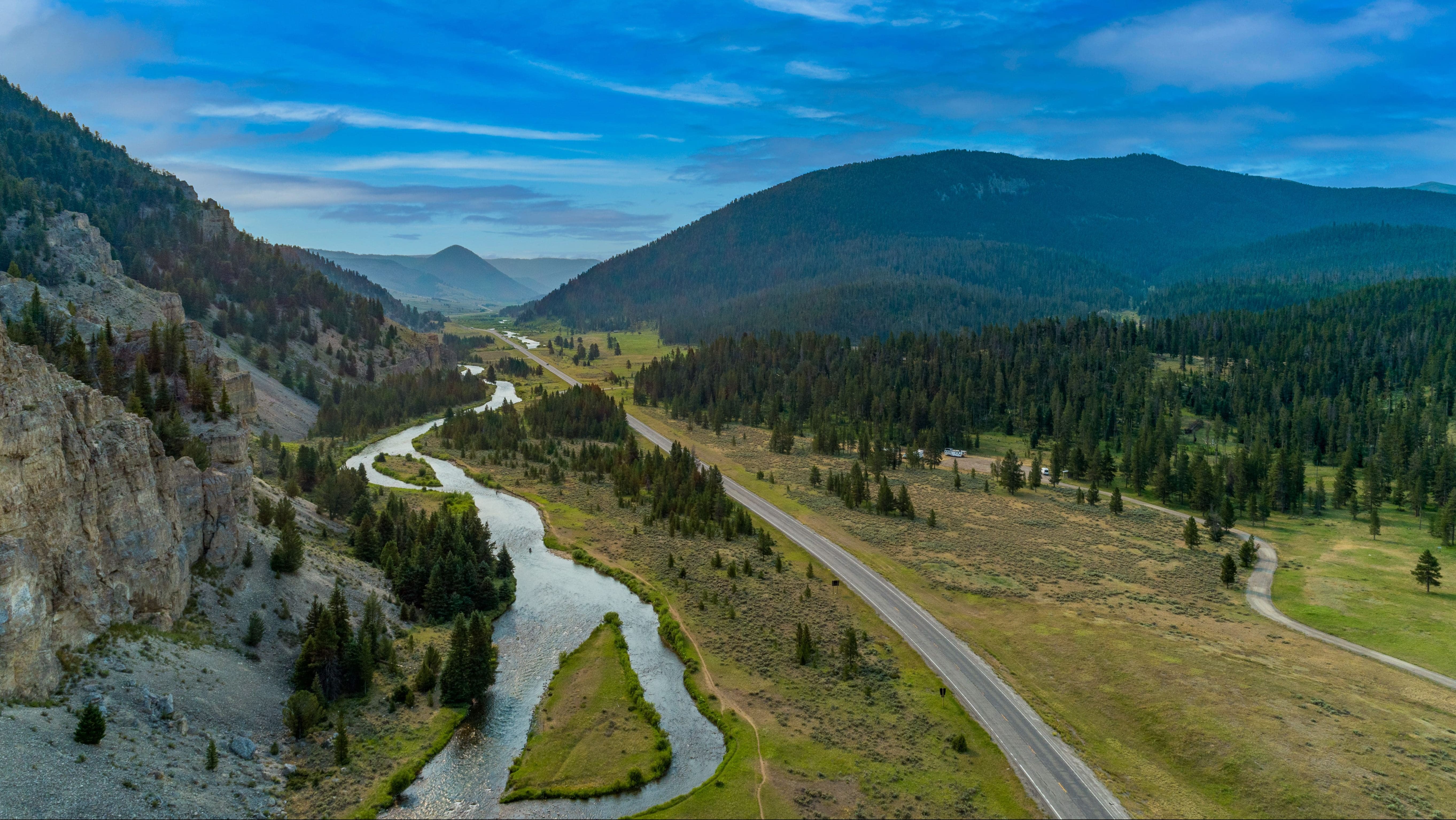
The Montana Department of Transportation has applied for federal funding to reduce collisions along U.S. Highway 191, one of Montana’s most wildlife collision-prone highways.
The Center for Large Landscape Conservation, a Bozeman-based nonprofit that works on ecological initiatives, announced Wednesday that MDT submitted a grant application to the Wildlife Crossings Pilot Program.
MDT’s proposal aims to make U.S. 191 safer for wildlife and motorists by providing a safer way for wildlife to cross the serpentine highway that connects Gallatin Gateway with Big Sky and West Yellowstone.
RELATED

Report calls for wildlife crossings to lessen collisions
A report describing how two Montana highways could be made safer for motorists and wildlife has conservationists optimistic that roadway changes are afoot in south-central Montana — or will be soon. The report comes after a year of high-profile crashes resulting in the deaths of iconic Northern Rockies species including dozens of bison and elk and at least one grizzly cub.
Over the past decade, parts of the highway have seen an 82% increase in average annual daily traffic counts. On a given day, more than 10,000 vehicles will travel U.S. 191, and during peak tourism season, that number can swell to more than 15,000 vehicles.
The project, which includes a wildlife overpass, upgrades to an existing underpass and a bridge retrofit, is estimated to cost $26 million. MDT submitted the proposal last month, pulling heavily from a study that CLLC released in October 2023 identifying wildlife collision “hot spots” and areas of the highway well-suited for a new crossing structure or a retrofit.
According to that study, one in four collisions on U.S. 191 involve wildlife — more than double the statewide average of 10%. Bringing that figure down is a “multi-year, multi-site, multi-stakeholder proposition that will take collective action,” according to the report.
Over the past decade, parts of U.S. Highway 191 have seen an 82% increase in average annual daily traffic counts. On a given day, more than 10,000 vehicles will travel it.
Due to the “overwhelming community interest” that developed in the wake of the study’s release, CLLC agreed to partner with MDT to submit the grant application and secured additional non-federal funding, according to lead study author Elizabeth Fairbank, a road ecologist with CLLC.
If MDT’s application is successful, the federal government will cover $22.8 million of the project’s cost, and non-federal partners will be required to supply the remaining $3.5 million. The Yellowstone Club Community Foundation and prominent Big Sky developer Lone Mountain Land Company have pledged to supply the majority of the matching funds, according to CLLC’s release.
“The generosity of companies, nonprofits and landowners who care about driver safety as well as safe passage for wildlife has been tremendous,” Fairbank wrote in a press release.
Warren Hansen, Montana Fish, Wildlife and Parks’ Region 3 wildlife manager, said that in addition to making highways safer for motorists and wildlife, crossings are “critical” for ecosystem health.
RELATED

How does the wildlife cross the road?
Once a leader in wildlife crossings, Montana is now “stagnant,” despite having one of the highest rates of animal-vehicle collisions in the country. Could a federal spending proposal reinvigorate the state’s efforts?
“By providing safe passage across busy roadways, like U.S. 191 south of Gallatin Gateway, we not only reduce vehicle collisions but also promote habitat connectivity, which is essential for sustaining Montana’s rich biodiversity,” Hansen said.
MDT Chief Operating Officer Dwane Kailey lauded CLLC for its role in bringing the grant application to fruition.
“CLLC conducted a sound assessment, worked with us to develop a viable project solution and raised the matching funds if we are awarded the grant,” Kailey said.
Gallatin Wildlife Association President Clint Nagel told Montana Free Press that his organization “wholeheartedly supports” efforts to reduce collisions along U.S. 191, which parallels the Gallatin River and bisects habitat for elk, moose, grizzly bears, bighorn sheep, foxes, bison, cutthroat trout and other species.
“Some of these issues are way too big for nonprofits. We can organize and raise public awareness around the issues, but when it comes to the funding and the mechanisms to get these projects underway, you’re going to have to have state involvement,” said Nagel, who is also a member of Montanans for Safe Wildlife Passages, a coalition of groups working on wildlife connectivity. “It is nice to see the state taking initiative here to do that.”
The federal government is expected to announce the projects approved for funding through the program, which was established by the Bipartisan Infrastructure Law of 2021, early next year.
RELATED

A road runs through it
Highway 191 between Bozeman and Big Sky is one of the busiest roadways in Montana, and one of the deadliest for wildlife. Solutions are a long time coming.
MDT’s application comes about a year after another project in Montana received funding from the Wildlife Crossings Pilot Program. The Confederated Salish and Kootenai Tribes received notice in December that its $8.6 million proposal to mitigate collisions along a stretch of U.S. Highway 93 that runs through the Flathead Indian Reservation was successful.
Earlier this month, the Montana Wildlife and Transportation Partnership announced that it is funding a study to explore the feasibility of building two wildlife crossings in parts of Paradise Valley where collisions between motorists and wildlife are particularly high. The Greater Yellowstone Coalition told the Billings Gazette that MDT has pledged to pay for the engineering study and will conduct the work along Highway 89 if other parties raise money for construction.
LATEST STORIES
Montana drops bison lawsuit against Yellowstone National Park
Motion to dismiss ends nearly two years of litigation, renewed tension over who gets a say in bison management
Poll: Rep. Troy Downing ahead in Eastern U.S. House District
A Montana Free Press-Eagleton poll conducted between Aug. 27 and Sept. 7 shows incumbent Rep. Troy Downing with a substantial lead over Democrat Brian Miller in their race for Montana’s Eastern District U.S. House seat.
What Missoula’s homelessness response looks like one year after Johnson Street shelter closure
The last 12 months without the 165-bed emergency shelter have left Missoula’s longstanding homeless shelter full more often than not and have strained other organizations serving people living on the street. Limited shelter capacity also means more people are living outside to navigate the city’s camping restrictions, providers said.
