


2/10/2025
“Great Falls This Week” is reported and written by Matt Hudson. Send your news and tips to [email protected].
Tax break would be the third for Calumet
Calumet Montana Refining has applied for a tax break on equipment worth $6.1 million. Cascade County commissioners will have discretion on how much of a tax reduction to give, but state law allows for a break of up to 100% on those assets.
The tax abatement is part of state law for certain manufacturing machinery, fixtures and equipment. County commissioners have until April 19 to approve and set the level of the tax break. The dollar value of the tax benefit isn’t yet available, according to county officials.
On Jan. 22, county Chief Financial Officer Trista Besich emailed Great Falls city officials to inform them of the application, which had been submitted a month earlier. Besich invited the city to give input on the request and indicated that the county plans to hold a public hearing on Feb. 28.
The tax break is intended to benefit new industrial equipment. In its application, Calumet listed 14 assets that began operation starting in 2023. Per state law, the abatement lasts five years at the rate set by the county. It is then phased out over the subsequent five years and taxed at the normal rate thereafter.
Calumet’s biodiesel subsidiary, Montana Renewables, is already receiving tax breaks from both Cascade County and Great Falls. That benefit gives a 50% tax break for the plant over five years, gradually phasing out after that. The city estimated it would miss about $2.77 million in tax proceeds over the life of the tax benefit. A county estimate wasn’t available.
Montana Renewables is also negotiating with the state to make its entire plant tax-exempt as “an air and water pollution control facility.” The company applied for the exemption in 2022 on the $430 million plant. After review, the Montana Department of Environmental Quality certified 8% of the plant’s equipment as tax-exempt pollution control assets.
Data from the U.S. Environmental Protection Agency show that greenhouse gas emissions at the Calumet site reached a 13-year high in 2023 — more than three times the recorded emissions in 2010.
Montana Renewables appealed the DEQ’s decision, and that case is pending before the Montana Tax Appeal Board. Together, Montana Renewables and Calumet are the largest taxpayers in the county with combined property tax bills close to $10 million. Based on current tax statements, a full tax exemption for Montana Renewables could erase more than $1.5 million in proceeds to schools, $1.8 million for Great Falls and $1.1 million for Cascade County.
Calumet also reduced its tax liability through protests from 2017 through 2019. Another protest regarding more recent tax years is currently under appeal.
In Memoriam
It was fortunate that Georges de Giorgio had a sharp memory because the details of his stories were often incredible.
De Giorgio sailed around the world for decades and had the adventures to prove it. He survived the largest-ever-recorded earthquake, hung out with Ernest Hemingway and Josephine Baker in Cuba and spent a year in Antarctica as a teenager. He was the harbormaster at the 1968 Olympics in Mexico City, where he befriended Harald, a Norwegian prince, who would later become the country’s king.
Later in life, he ended up in Great Falls, where he lived for nearly three decades. It was Montana where longtime friend Chuck Irestone first met de Giorgio. Over time, de Giorgio regaled Irestone with the incredible details from his travels.
“It was really just shock and amazement,” Irestone told Montana Free Press. “For one, it was coming from someone who became landlocked.”
Georges de Giorgio died on Jan. 27 at the age of 96. His obituary called him one of the last true great explorers of the 20th century.
Born Georges Rudolphe Barbaro de Giorgio to an Italian father and a Chilean mother in Chile, de Giorgio got his first taste of adventure when he talked his way into a yearlong American Antarctic expedition aboard the U.S.S. Beaumont in 1947. De Giorgio was 17 and was already a skilled seaman, having been brought up around his father’s sailboat-building business.
“When I finished my first year in Antarctica, I said, ‘It’s really cold here. Goodbye, Antarctica,” de Giorgio recalled in a 2020 StoryCorps interview. “And I waved as the ship took us away. And less than a year later, I was back for another year.”
De Giorgio spent the next 30 years on the sea. In Tahiti, he met Marlon Brando on the movie set of “Mutiny on the Bounty.” (Brando was “a pretty good guy,” de Giorgio told The Great Falls Tribune in 2019.) In 1951, after limping into a Cuban harbor on a damaged ship, he met Ernest Hemingway and Josephine Baker. Also on that trip was De Giorgio’s father, who didn’t read much and asked who that Hemingway character was.
“My dad said, ‘Well I don’t like him, because he looks like a bum,’” de Giorgio said in 2020.
After many more adventures, de Giorgio raised a family in the Los Angeles area before moving to Great Falls in the ‘90s. It became his northern, landlocked home.
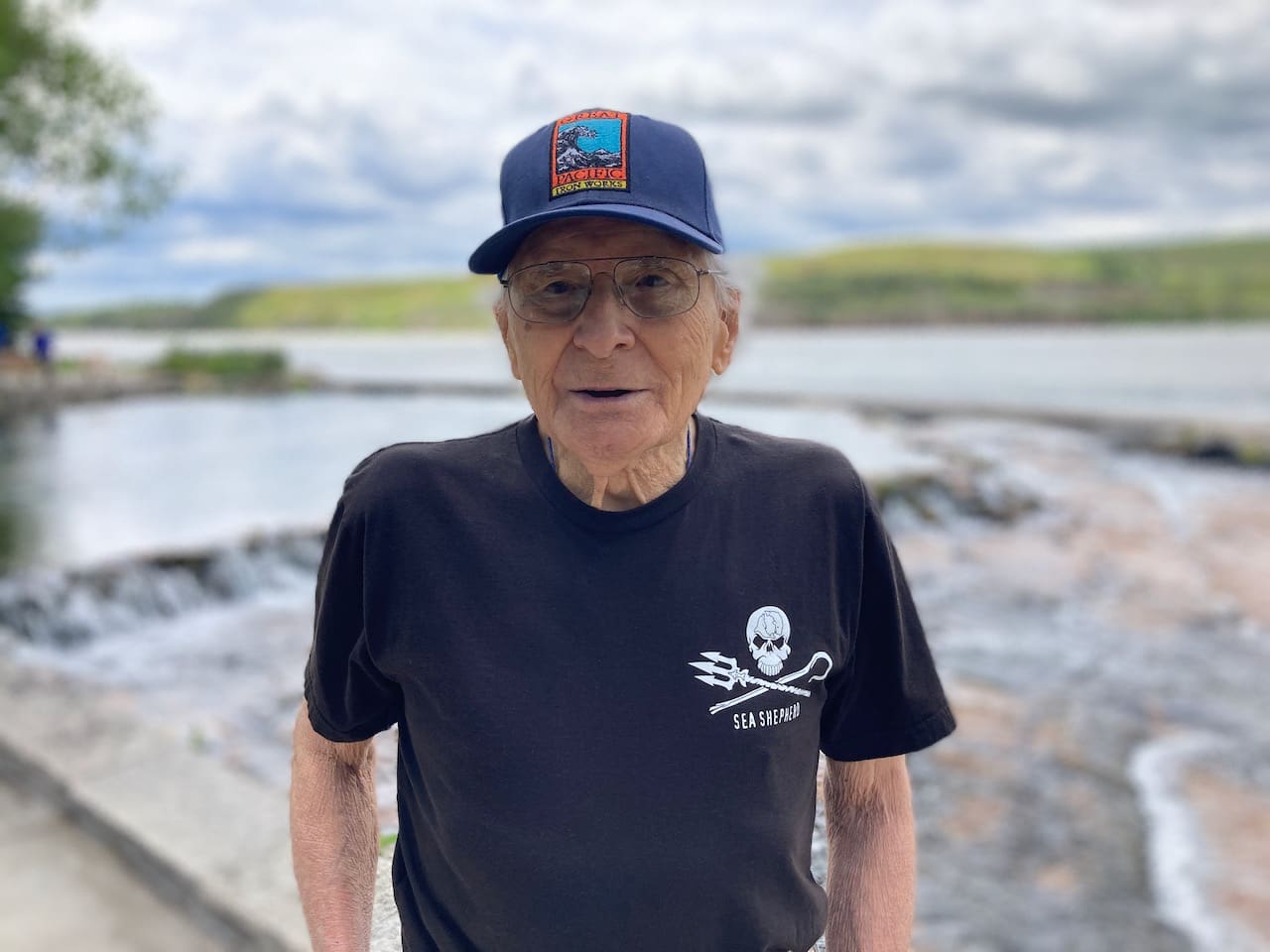
“He absolutely loved it, because it was the crossroad of explorers,” Irestone said. “There were Lewis and Clark. There was all the native American history, and that was right up his alley.”
De Giorgio worked at the Lewis and Clark Interpretive Center for eight years. He volunteered at the Great Falls Public Library and the Cascade County Historical Society, and he became a fixture for 20 years at the Ursuline Centre as a tour guide, night watchman and docent.
De Giorgio admired Indigenous peoples, having met members of different native cultures across the world. In Montana, he worked often with members of the Blackfeet Nation. As one story goes, he trapped and relocated a bear cub with Kqyn Kuka, a Blackfeet member and tribal liaison for Montana Fish, Wildlife and Parks. De Giorgio was 91 at the time.
In 2022, de Giorgio faced compounding health issues and returned to California to be closer to family. He remained sharp and in good spirits, always able to recount the names of the people — and ships — he met along the way.
Irestone will remember de Giorgio as always kind, magnetic and loving of humanity. That spirit carried him around the world and into history books.
“It’s so hard to sum up. He’s the oldest useful person that I know,” Irestone said. “And he always had that spirit to try new things and always adventure. He was always up for going on an adventure.”
More on de Giorgio:
StoryCorps interview with Chuck Irestone
Antarctic expedition stories on The Trail Less Traveled
A look at the ‘most interesting man in the world’ (GF Tribune, 2019)
Hold Up
Montana DAV, a veterans service organization that provides free transportation for military service members, wasn’t surprised when the Trump administration’s hiring freeze held up the process of hiring a staff member.
What came as a surprise was that they couldn’t add volunteers, who often are the drivers for DAV’s network of vehicles across Montana, including Great Falls.
“We’re trying to hope to get this damn thing resolved so we can get these people on the books,” said Commander Kevin Grantier of Montana DAV. “It’s hard enough to get these volunteers and process them.”
Grantier told Montana Free Press that the nonprofit has around 79 volunteers and a fairly high turnover rate, given the nature of the work. They’re always looking to add volunteers to the roster. Grantier said the organization had been looking to add two or three drivers when it learned about the freeze from the VA.
“Every year we drive over a million miles and bring thousands of veterans to their appointments,” he said. “And with any of that going on, there’s always a constant rollover.”
He said the VA considers volunteers to be “non-paid VA employees” who couldn’t be onboarded during the freeze.
DAV Montana was also in the process of hiring a hospital services coordinator, a paid staff position. That process has also been put on hold.
Grantier said that a team from DAV Montana will soon head to Washington, D.C., to press for reinstatement of volunteer onboarding.
Photo Op
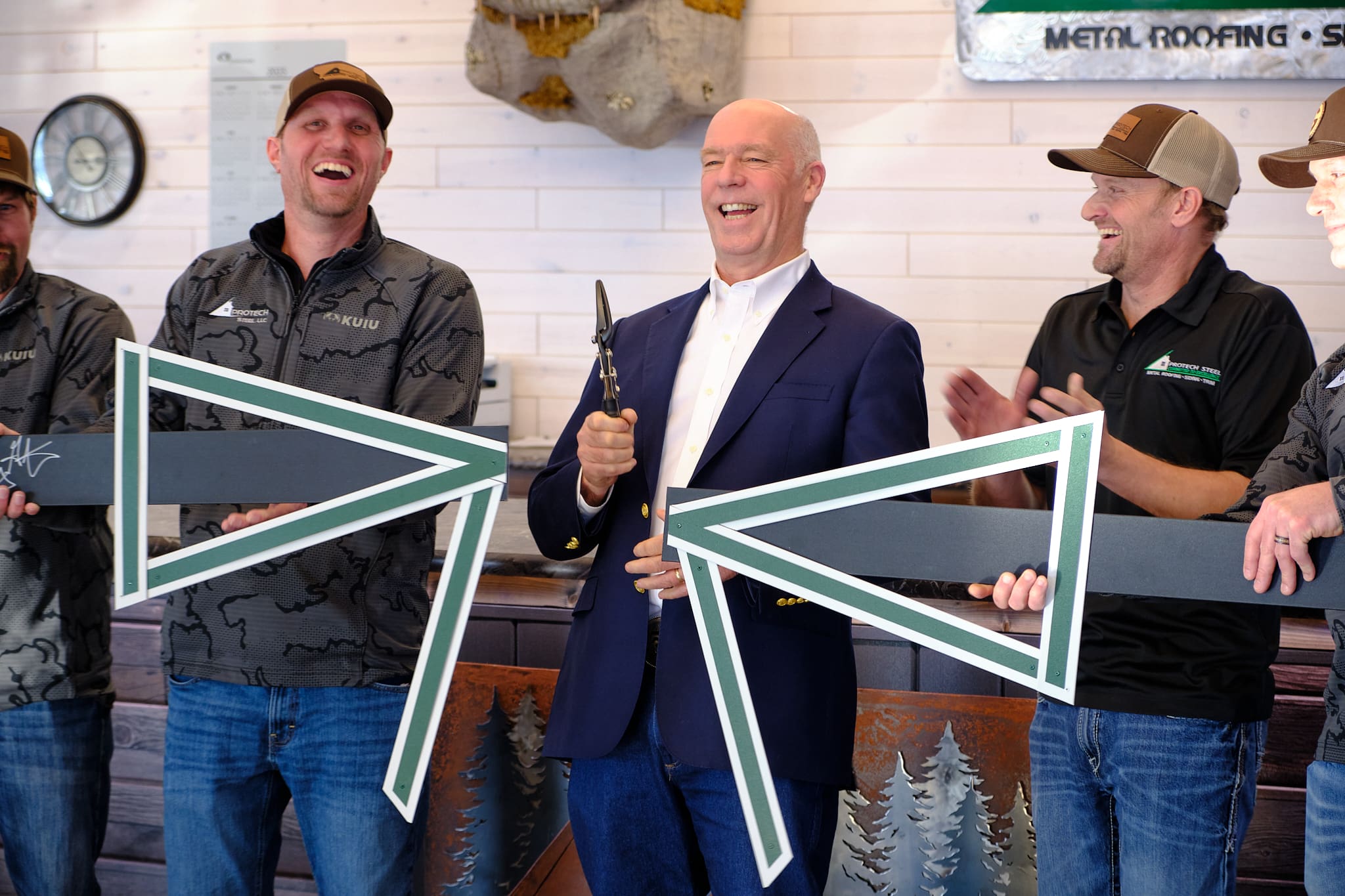
Using tin snips, Gov. Greg Gianforte cut the metal ribbon at the new Great Falls headquarters for Protech Steel on Feb. 5. The company, which started in 2014, outgrew its original Great Falls location and moved into the new building along the Vaughn frontage road less than a month ago. Protech CEO Calvin Stoltzfus gave introductory remarks.
Speaking to a crowd of Protech employees and supporters, Gianforte touted plans for an income tax cut (read more about that here).
“If you think about it, income tax is literally a tax on work,” he said in front of a crowd at Protech. “And we should be encouraging work, not discouraging. When we over-tax work, we discourage work.”
He also pitched his leading property tax proposal: a homestead bill that reduces the tax rate on primary residences, shifting the burden to second homes and short-term rentals (more on that here).
Calling all photographers: Submit a photo for Great Falls This Week to [email protected].
Everything’s Great When You’re…
Downtown Great Falls took the spotlight during a Feb. 4 city work session as Great Falls Development Alliance CEO Brett Doney shared findings from market research completed last fall.
The market research projected a growing demographic of young, college-educated residents for Great Falls. These would be ideal buyers and renters for townhome and apartment residential development, further supporting recent commercial growth in entertainment and food and beverage businesses. At the same time, projected low demand for office space and ample vacant office property leave openings for residential redevelopment.
Some of the best opportunity sites are found on little-used surface parking lots, some of which are owned by the city. Public parking lot occupancy is below 50% on average, according to GFDA data.
“We have plenty of parking,” Doney said. “We’ve got too much parking downtown. And when parking sits empty, it’s expensive.”
These lots are prime for development into townhomes or condo units for younger, urban-centric homeowners and renters. Some building styles can incorporate and retain the surface parking on the ground level while building housing units atop. Doney offered the large parking lot on First Avenue South and Second Street South as an example of an opportunity site.
In addition, Doney said his team is eyeing so-called “catalyst sites” that could get a more direct pitch for potential developers. Through a development program aimed at rehabilitating aging properties, GFDA hopes to build criteria to solicit site proposals and match them with developers. These efforts would hope to match the right kind of development with what GFDA’s data says downtown could support. A conference hotel was one option he pitched. And, of course, housing.
“We also think some market-rate housing development, very similar to The Station District, would be very beneficial downtown,” he said.
A previous report commissioned by GFDA called for a demand of around 650 housing units annually in Great Falls over the next decade with current supply projections falling short. Much of Doney’s downtown information comes from a market analysis delivered last fall. The 124-page document is filled with residential, commercial and visitor information to guide private and public development.
The market report also tracked visitor trends, including spikes in downtown visits during key events and new business openings. One finding was that between 2018 and 2024, the 400 block of Central Avenue saw the most weekly visitors — more than 4,500 and 1,000 more than the second-place 500 block. Events have been key drivers of downtown visits.
“We’ve come a long way,” Doney told commissioners. “We’ve got good momentum and a really core group of local developers, property owners and businesses that have been very helpful. They know that bringing more downtown, they’re going to benefit.”