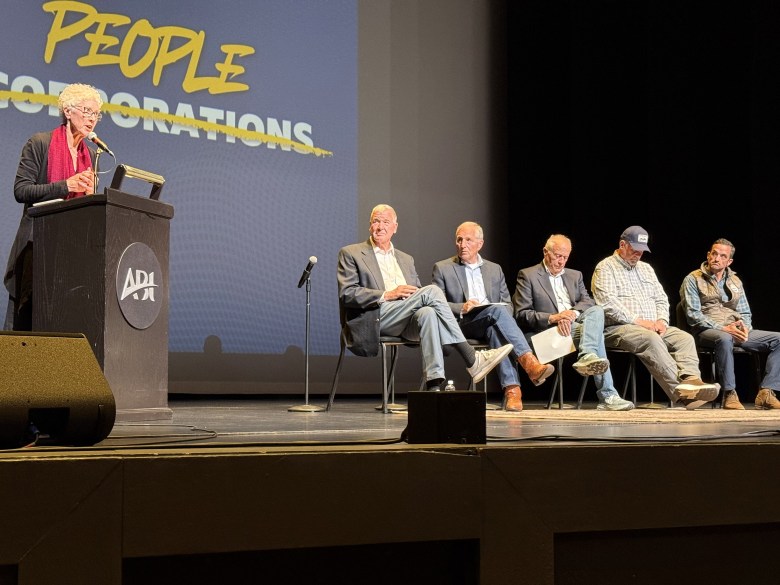
Supporters of a ballot initiative to ban corporate spending in Montana elections hosted a Q-and-A at the Alberta Bair Theater in downtown Billings Wednesday night.
Attendance was sparse, with more than half of the theater’s 684 seats empty — a far cry from the roughly 800 people who attended a similar event in Billings in February.
The audience was overwhelmingly retirement-age, and there were grumblings about the dearth of younger people. Retired Montana Supreme Court Justice Mike Wheat moderated.
The night was initially organized as a debate.
Proponents of I-194, also called The Montana Plan, were local businessman and former independent congressional candidate Gary Buchanan; former Democratic congressional candidate Russell Cleveland; Billings attorney Gene Jarussi, who was appointed to help prosecute campaign finance violations under former Commissioner of Political Practices Jonathan Motl; former Republican Gov. Marc Racicot; and former Democratic Sen. Jon Tester.
Todd O’Hair, president of the Montana Chamber of Commerce, had been scheduled to argue against I-194, but after initially agreeing to do the event he later backed out. O’Hair said he wasn’t able to find another person to join him on stage across from Tester, Racicot and Buchanan. (Cleveland and Jarussi were added to the program later.)
“You know, you’ve got three individuals and me,” O’Hair said in a phone call with Montana Free Press on Monday. “Three brains, and two of the brains, at least, are very skilled politician types.”
The chamber was roasted throughout the night for failing to show. On the stage, two seats were placed opposite the lineup with signs for the Montana and Billings chambers of commerce. Both had declined to participate.
“So, my friends [on stage] here have come hundreds of miles,” Buchanan said in his introductory remarks, “and my own chamber couldn’t walk across the street tonight.”
The Montana Chamber of Commerce was one of the groups that unsuccessfully intervened in a lawsuit earlier this year in an attempt to block the corporate spending ban from reaching the ballot. It was joined in that effort by the Montana Mining Association, the Montana Petroleum Association, the Montana Stockgrowers Association and other industry groups.
O’Hair said the Chamber would continue to urge a “no” vote on the measure because, he said, it would have a chilling effect on corporate activity in Montana, including efforts to pass school levies, bonds and other civic funding measures.
“I don’t buy any of that,” Buchanan said in response. “I’ve never seen anything before Citizens United that could not have passed if people had to say who the hell they were.”
Citizens United, the watershed U.S. Supreme Court ruling in 2010, unleashed a flood of money into American elections by allowing unlimited corporate spending. It marked a drop in face-to-face “retail” campaigning, increased reliance on messaging from political interest groups and the growing influence of wealthy organizations.
The Montana Chamber has been campaigning against I-194 in its fall voter guide and through communications with member organizations and speaking engagements with groups like Rotary Clubs and the Montana Hospital Association.
Proponents of the measure on Wednesday said electoral campaigning has changed dramatically over the years. Tester said that in 2006, he and opponent Conrad Burns met on stage often.
“God, I can’t even tell you how many debates we had. More than I have fingers, let’s just put it that way,” he said.
Racicot said his family got tired of all the public appearances required of them during his first statewide campaign in the 1980s.
“My children, to this day, have great disdain for parades,” he joked.
Initiative organizer and former Montana Commissioner of Political Practice Jeff Mangan told the crowd that “for the first time in 20 years” a Montana voter initiative had qualified for the ballot with only volunteer work and no paid signature gatherers. In a little more than three months this spring, backers collected 50,000 signatures to qualify the measure for the ballot. They needed just 30,000.
LATEST STORIES
Jacobsen responds to legislative subpoena
Montana lawmakers trying to get to the bottom of what state voter information was shared with the federal government say they still have questions, despite a subpoenaed response from Montana’s secretary of state.
Poll: Cost-of-living important factor for 80% of Montana registered voters
Montanans are having ongoing challenges affording housing, healthcare, gas and groceries, according to a new Montana Free Press-Eagleton poll of registered voters.
Poll: Nearly 75% of Montana registered voters oppose new data centers
A new poll from Montana Free Press and Rutgers finds nearly three-quarters of Montana voters oppose data centers being built in their city or a neighboring county.