
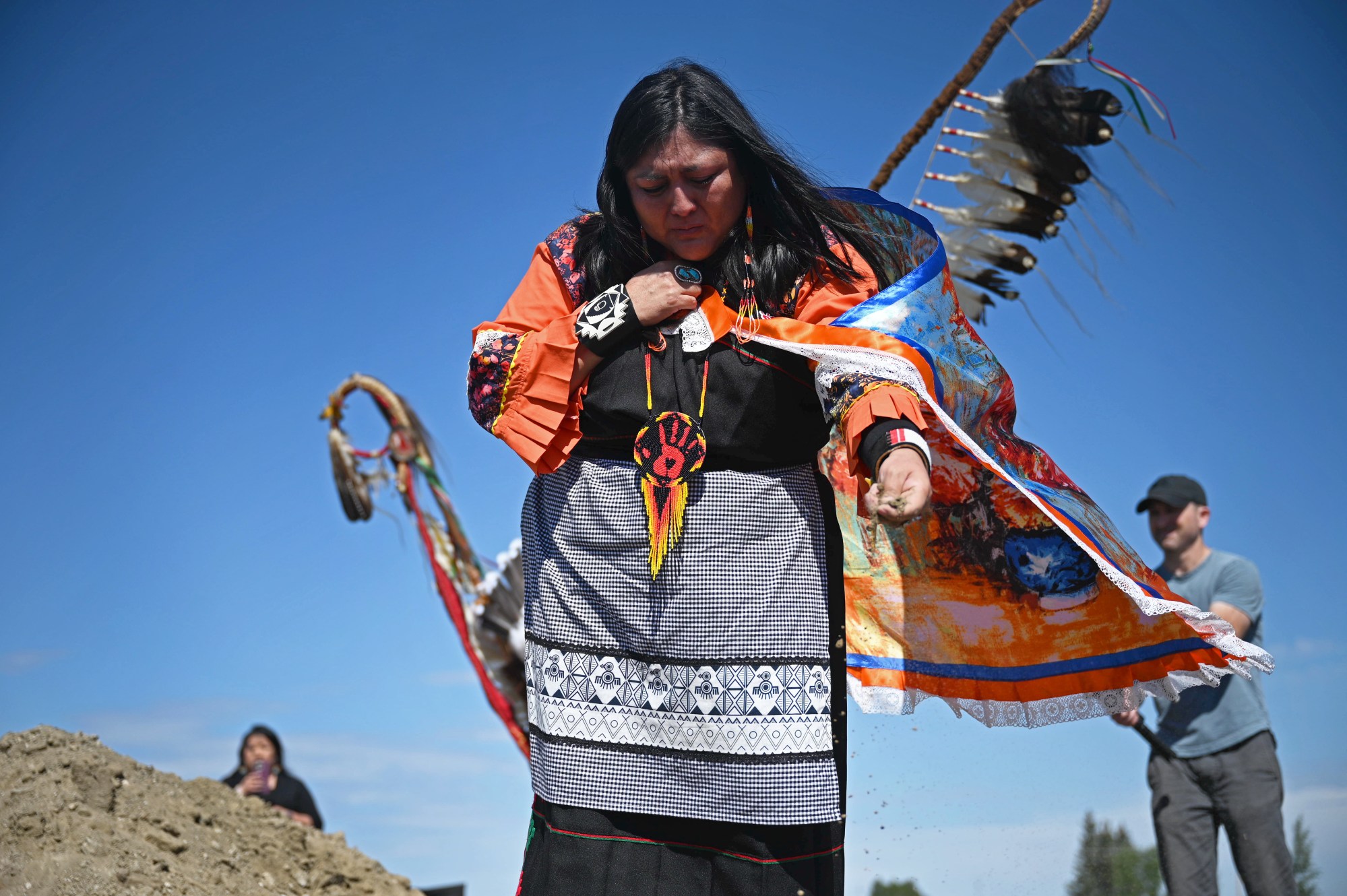


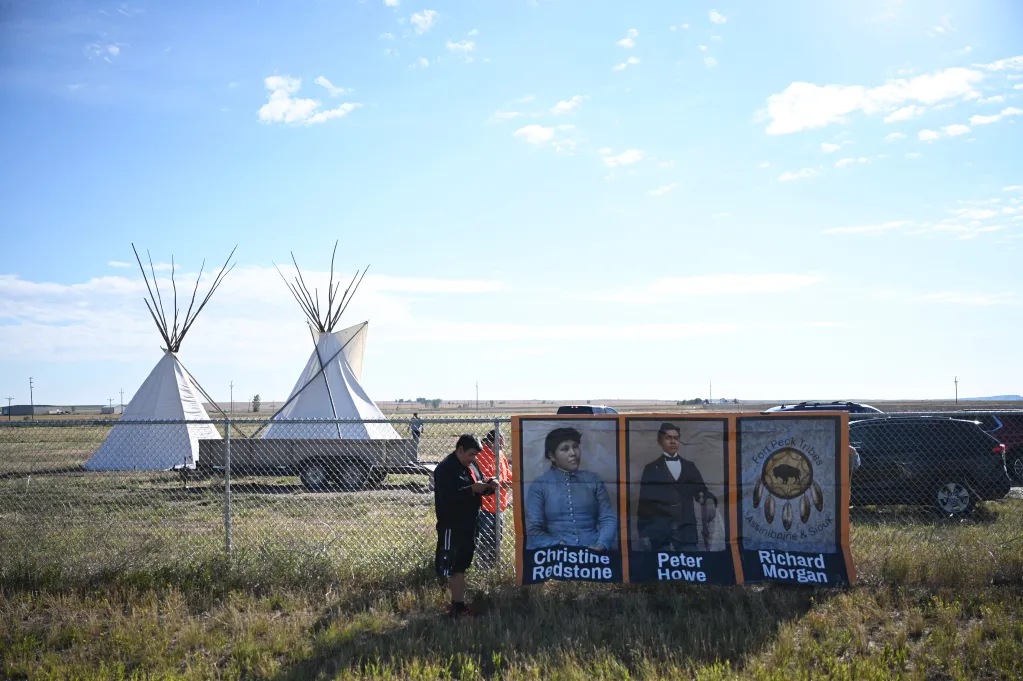
FORT PECK — They met them at the reservation’s eastern boundary.
It was a cool, blustery early-fall afternoon, and citizens of the Fort Peck Assiniboine and Sioux Tribes had gathered to meet a caravan that had traveled more than 1,800 miles from Pennsylvania.
Included in that procession of vehicles from the east were the remains of three “relatives,” just teenagers when they left their home in the northeastern corner of Montana in the 1890s, who later died at the infamous Carlisle Indian Industrial School — one of the nation’s largest boarding schools during the Indian assimilation era.
More than 130 years later, the remains of Christine Redstone, Peter Howe and Richard Morgan were finally home.
A white van leading the convoy home stopped briefly on Big Muddy Creek Bridge, marking the reservation boundary. Families embraced, tears were shed, and the smell of burning sage lingered. In the back were three wooden caskets draped in the flags of the Assiniboine and Sioux.
The vehicles then headed west through the reservation, passing small communities where people in orange clothing lined the streets, the color meant to honor the victims and survivors of Indian boarding schools. They held signs, all welcoming the remains home.
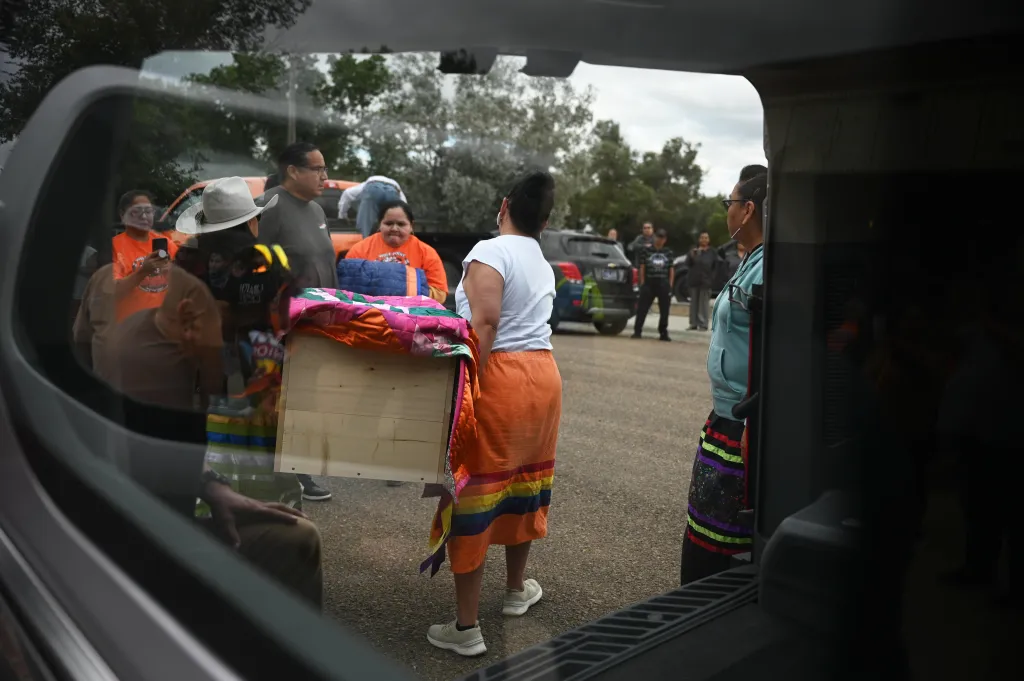
The following days included community celebrations, speeches and, finally, the reburials. For those directly and indirectly involved in transporting the remains home, including living descendants of the youths, it was a time of grieving, healing and reconnection.
“ Today is a beautiful day, and it’s been a long, long road, but our children are finally home; they are home where they belong,” said the tribe’s former chairman, Justin Gray Hawk Sr., during one of the reburial ceremonies.
WHO THEY WERE
According to historical information kept by the former school, all three teens arrived in Carlisle April 15, 1890. Christine Redstone was 15 when she left Fort Peck. The daughter of Assiniboine Chief Redstone, she died at Carlisle on July 19, 1899. She would have been roughly 24 years old at the time of her death.
Peter Howe was 16 when he entered Carlisle and died at about age 22 on June 5, 1896; Richard Morgan was 17 when he arrived at Carlisle and died less than a year later on March 25, 1891.
All three died of tuberculosis.
Before the homecoming, a dozen tribal members traveled to Pennsylvania at the end of August.
Those in the group told Montana Free Press that they felt a range of emotions during their time in Carlisle. They shared how they prayed and laughed. They shared how they toured the school grounds and what it felt like to see the cemetery where the children had been buried.
But trying to find the words, trying to describe the significance of bringing these bodies back to Montana, proved difficult.
“This was a new one for me,” said Fort Peck councilman Barry Bighorn, who was joined by his wife as part of the coalition that traveled to Carlisle.
“It is important,” Bighorn said. “But how do you, how can anyone appreciate it if they haven’t experienced it?”
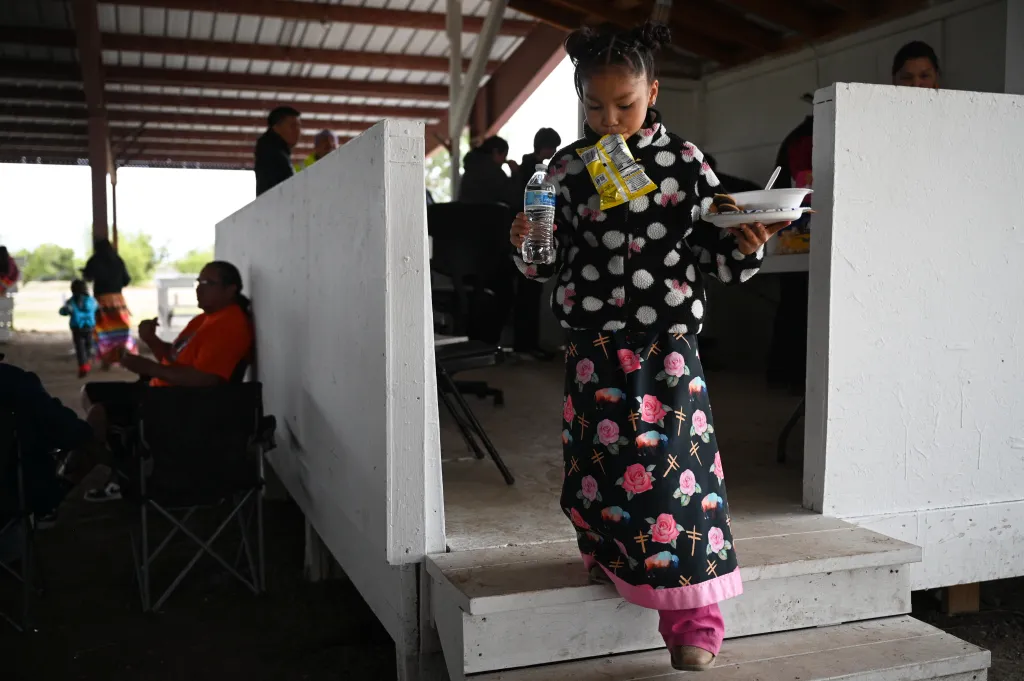
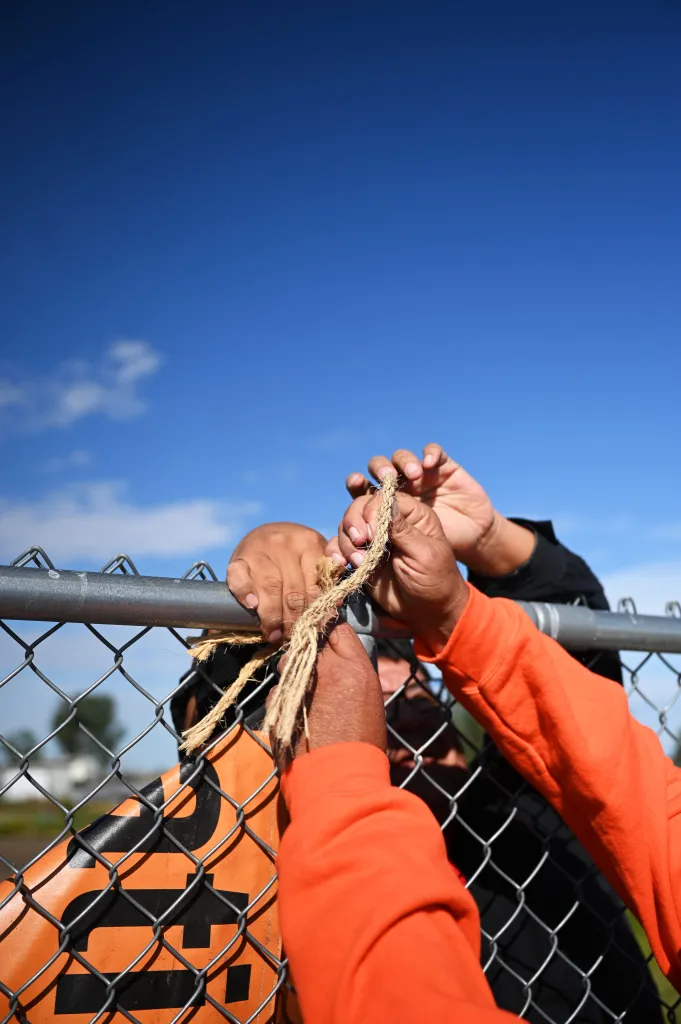
Joining their visit was Amanda R.J. Cheromiah, the executive director of the Jim Thorpe Center for the Future of Native Peoples at Dickinson College, an organization that promotes Indigenous truth-telling, history and sovereignty. She is also a descendant of a family member who attended Carlisle.
“I live, work and pray in Carlisle,” Cheromiah told MTFP during one of the community meals. Her job in these repatriation missions is to help “lessen the blow.”
But a week with the Fort Peck tribal members was not enough time. Cheromiah didn’t originally plan to travel to Montana, but she said she realized that she needed to see the repatriation through.
“My heart is like ‘I feel compelled to go,’ because I feel like I need to finish the ceremony … and to witness and be a part of the community, really, to see the children come home and be with them,” Cheromiah said. “ We’ve been with them at Carlisle.”
The repatriations at Fort Peck were another part of the nation’s convoluted history with tribal nations. Opened in 1879, Carlisle was the first federally run boarding school, operated by the U.S. Department of the Interior.
Its stated purpose was to assimilate Indigenous youth into white culture by separating them from their families, homelands and culture. The school’s superintendent from its opening in 1879 to 1904, Richard Henry Pratt, argued that Carlisle was the ideal institution because the school “fully immersed” the students in white culture, according to historic documents kept at the Carlisle Indian School Digital Resource Center.
“A great general has said that the only good Indian is a dead one, and that high sanction of his destruction has been an enormous factor in promoting Indian massacres,” Pratt wrote. “In a sense, I agree with the sentiment, but only in this: that all the Indian there is in the race should be dead. Kill the Indian in him, and save the man.”
By the time the school closed in 1918 to make way for veterans returning from World War I, Carlisle had served as a model for other boarding schools across the nation “to civilize the Indians,” according to the National Archives and Records Administration, and had been home to about 7,800 students. Some of the buildings still stand on what is now the United States Army War College campus. Self-guided tours of the school, where 232 students died, are available.
PETER AND RICHARD
The two boys, Peter Howe and Richard Morgan, were buried Sept. 9 in Poplar following a parade through the town that ended at the cemetery.
“There’s a lot of emotion from all of us, and today we get some healing from our children coming home,” said Gray Hawk Sr., one of the speakers at the boys’ reburial. “Today, we show our resilience. We show our strength by coming together to support these two boys.”
For some, the repatriation meant learning how to forgive, at least for former Fort Peck councilman and cultural leader Tommy Christian, who traveled to Pennsylvania and back with the remains.
“ I had some trusting issues that I really had a hard time dealing with,” Christian said during the boys’ reburials. “These three individuals helped me to bring that to the surface and really deal with this ability to trust others in good ways. … I wanna thank these three individuals for giving me that opportunity.”
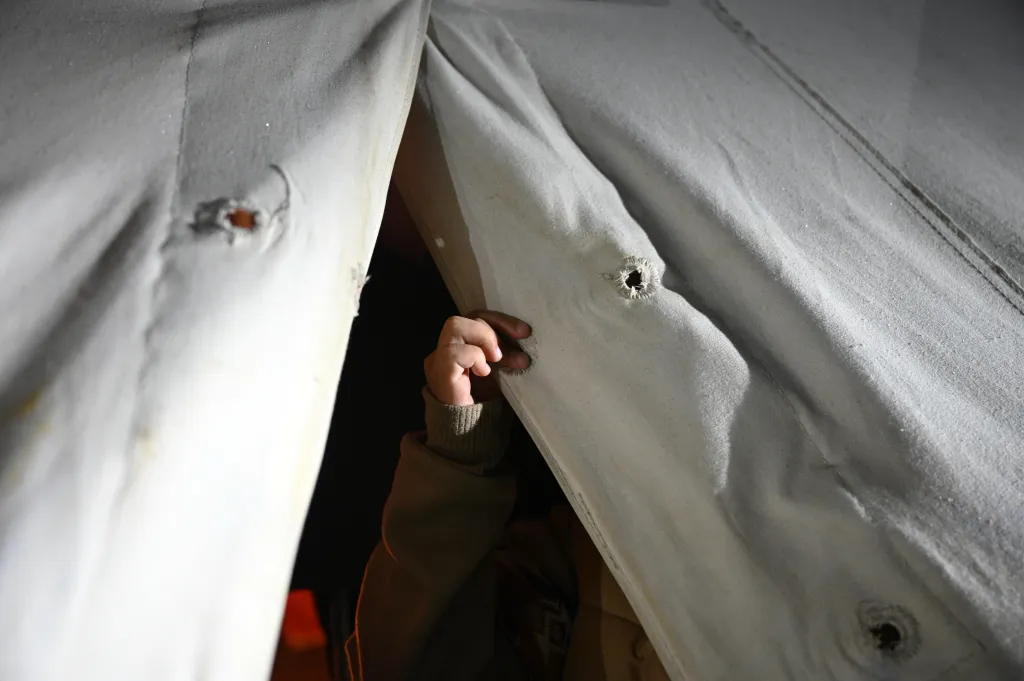
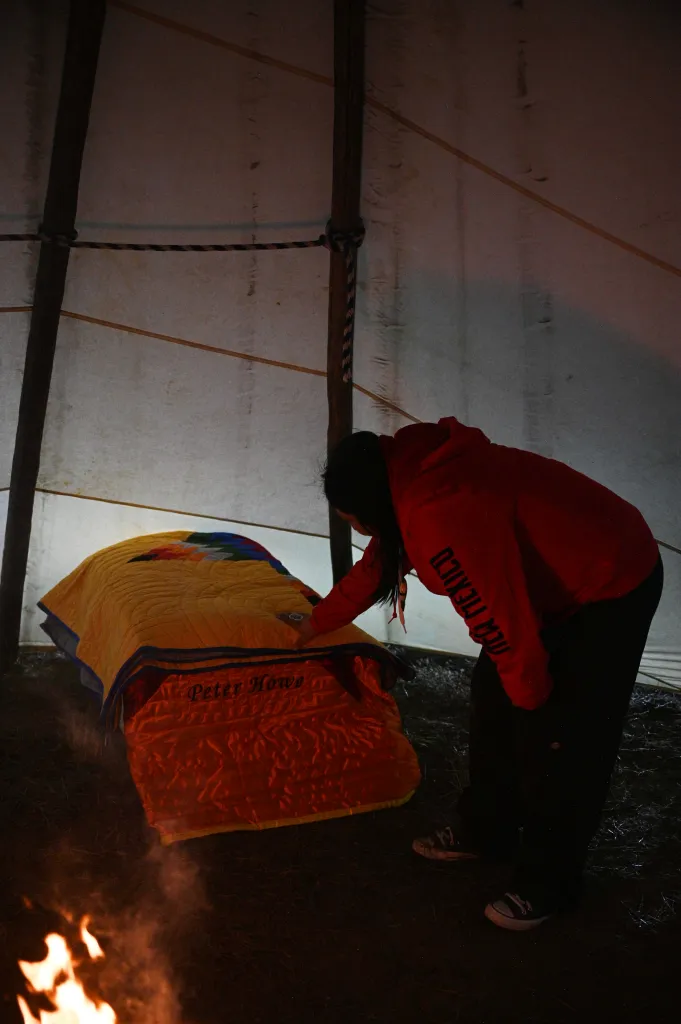
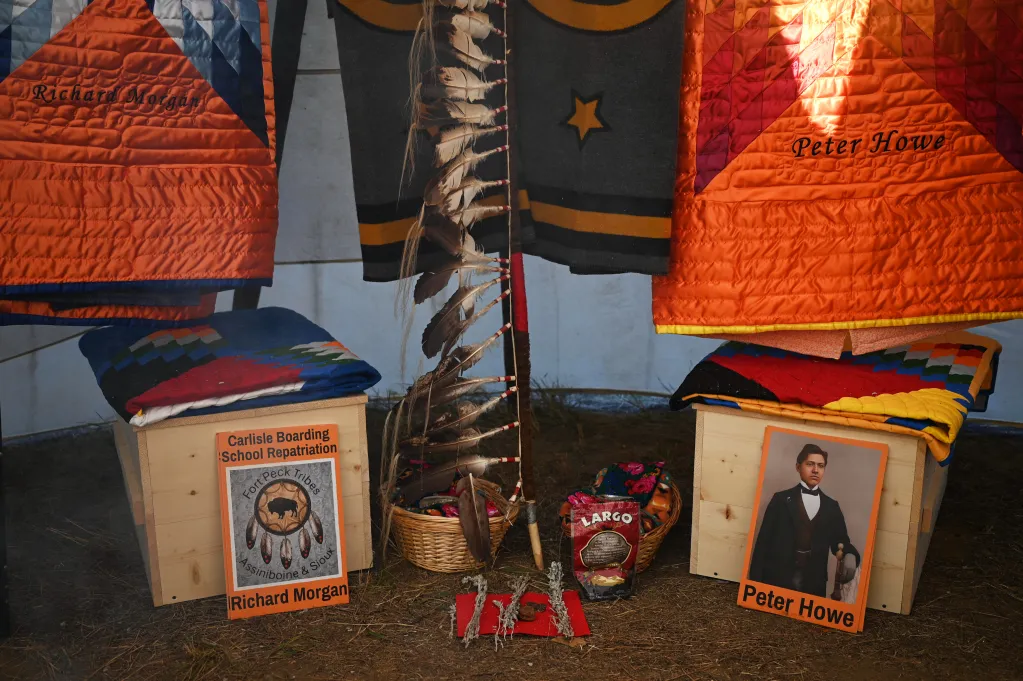
A tipi was erected to shelter the two boys overnight at the cemetery before their reburial. Adrian Pipestem, a community member who traveled to Carlisle, stayed with them overnight and kept a fire burning.
Throughout the night, Pipestem said he thought about his own children.
“ My kids got it so good compared to what these kids went through,” Pipestem told MTFP. “I couldn’t imagine getting my kids taken away and not seeing them ever again.”
CHRISTINE
After Peter and Richard were laid to rest, the wake for Christine Redstone was held in a community center in Frazer, the most western community on the reservation. And, unlike the two boys, Christine has descendants who still live in Frazer. Her family chose to rebury her at the cemetery in Oswego, a short drive away, the following afternoon.
During Christine’s wake, attendees were invited to speak, and Michelle Feather Earring Harada reflected on her relationship with her Indigenous culture and why it’s important to hold on to. She added that she is grateful that stories from the trip to Carlisle were being shared with the community, especially the youth who were in attendance.
“I really hope again that the kids that are here will remember this, because this is history live right here,” Feather Earring Harada said. “This isn’t no History Channel. This is it right here, right now. And for me, I’m honored to be a part of this.”
Among the Redstone family were four cousins who all traveled to Carlisle to bring their great-great-grand aunt Christine home. With them was Michael Redstone, who admitted she felt angry upon arriving in Carlisle.
“I remember calling home, like three days in, like, ‘ I’m done, I’m ready. I wanna come home,’” Redstone said during the wake. “And I could just imagine, like, what [Christine] had to deal with being there for so long.”
What helped her process those feelings, Redstone said, was imagining the other Fort Peck kids sticking together and supporting one another at school.
“They just knew how to break us,” said Redstone, “by taking our kids.”
Throughout the homecoming celebrations, Dyan Youpee-Scott, the tribes’ cultural preservation director, was busy helping set up before the wakes, instructing people on where to go for the services and handling almost everything else in between.
Although Youpee-Scott kept her emotions in check during her work “in order to get the job done,” she made sure that the trip to Carlisle, the journey home and all the events leading up to the reburials were shared by creating a public Facebook group where details and other updates were regularly posted.
“ People wanna be there,” Youpee-Scott told MTFP the Friday following the reburials. “There are elders who can’t travel.”
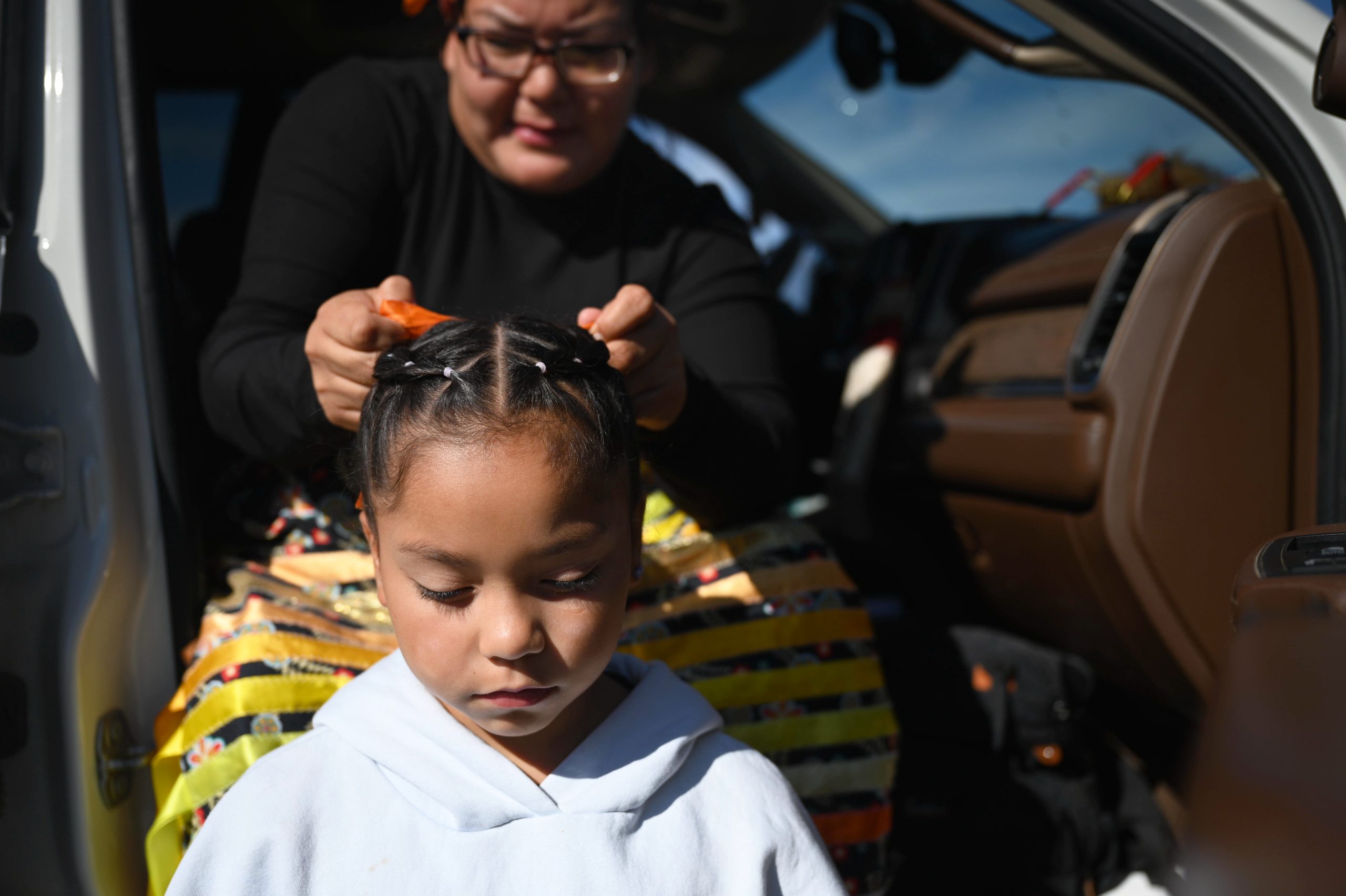



- Raean Scott gets her hair braided before a procession through Poplar and the reburial ceremonies for Peter Howe and Richard Morgan, Sept. 9, 2026, in Poplar.
- Mila Gramling warms up with her Poplar cross-country teammates before running from Poplar High School to the cemetery as part of a procession honoring Peter Howe and Richard Morgan, Sept. 9, 2026, in Poplar.
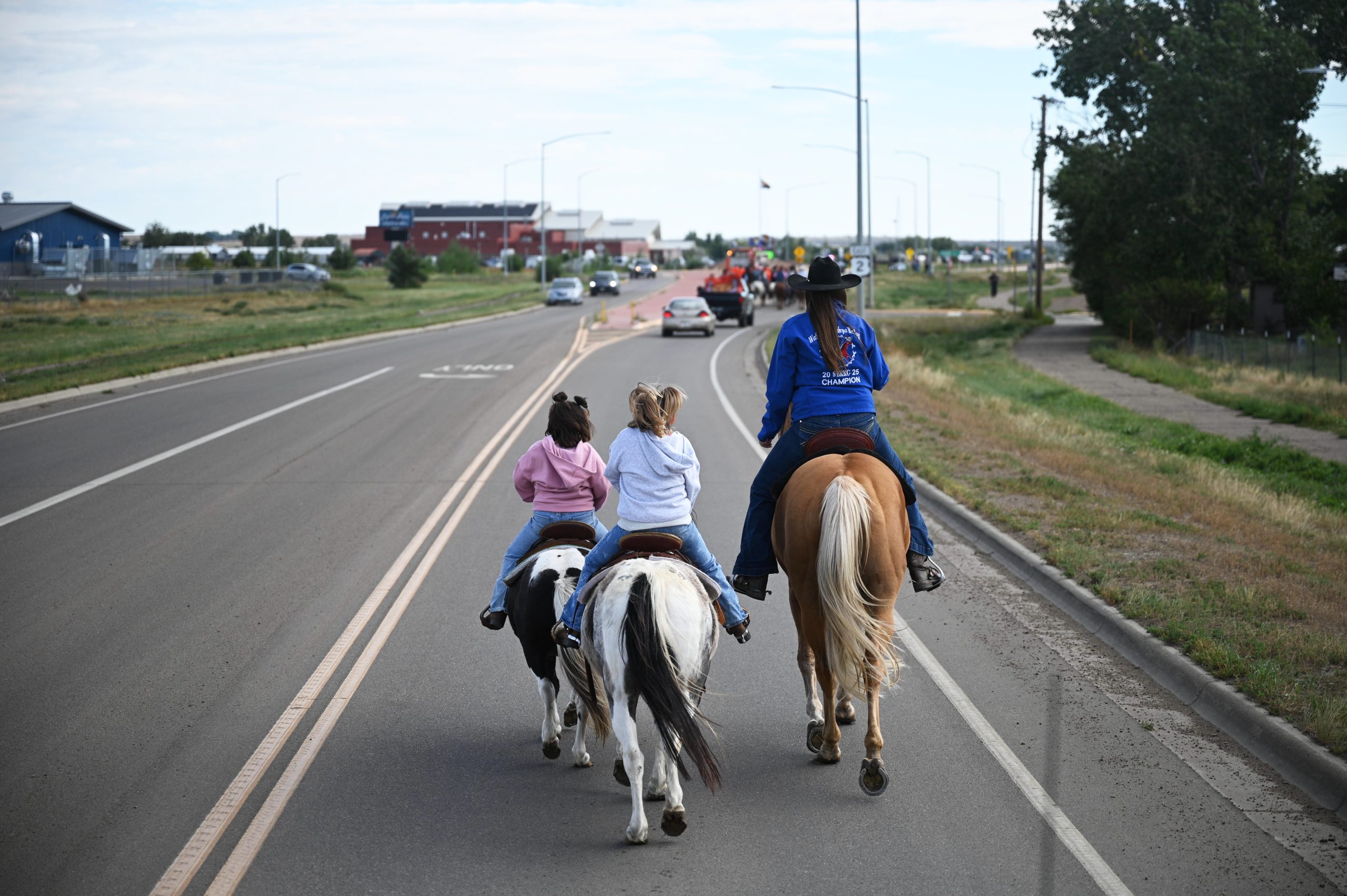
- Greer Wagner, Isla Wagner and Emma Gourneau ride horses from Poplar High School to the cemetery as part of a procession honoring Peter Howe and Richard Morgan, Sept. 9, 2026, in Poplar.
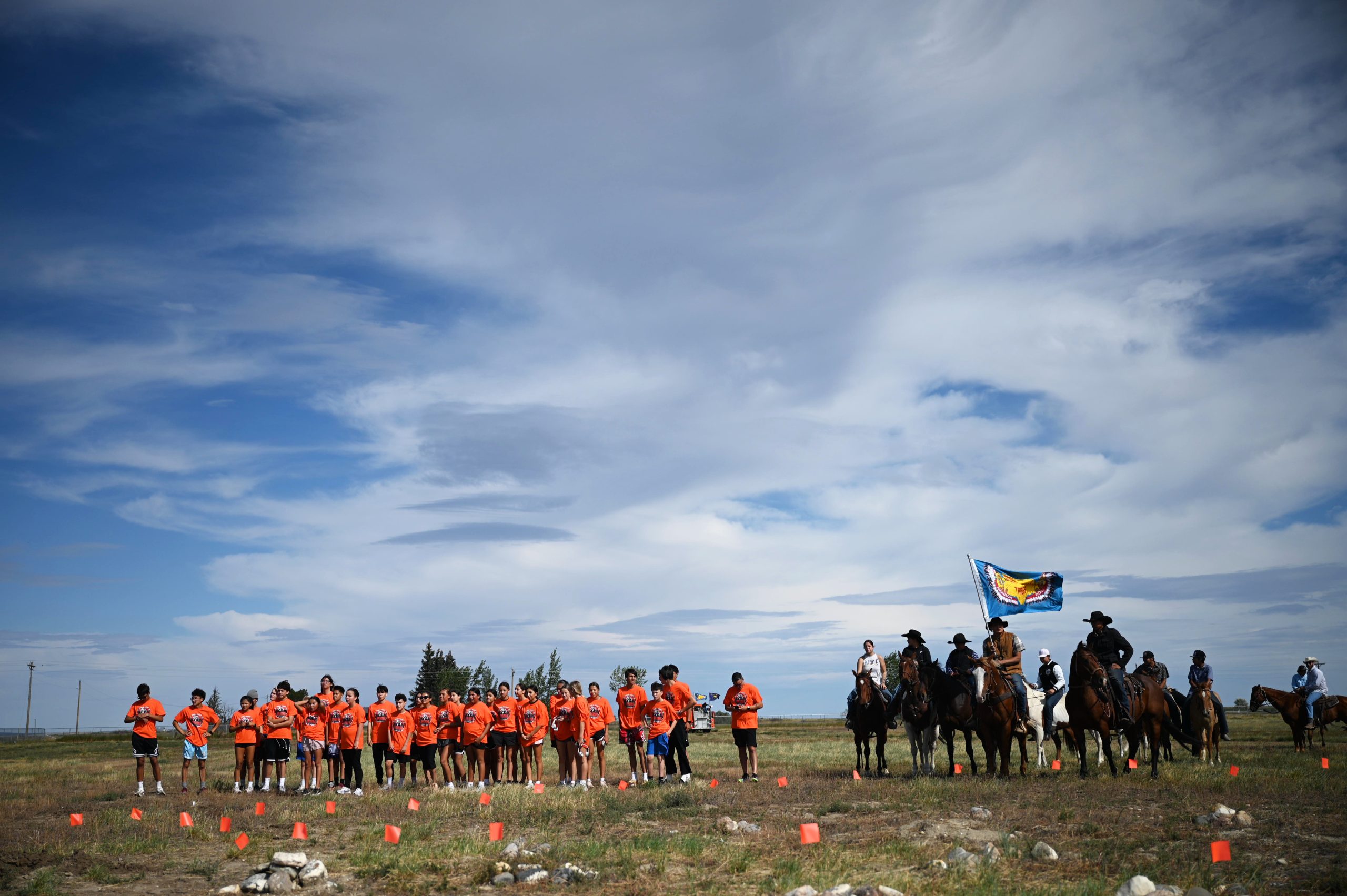
- The cross-country teams from Wolf Point and Poplar, along with local ranchers and horsemen, stand in the cemetery as part of the reburials of Peter Howe and Richard Morgan, Sept. 9, 2026, in Poplar.
- Lance FourStar takes a moment during the reburial of Peter Howe and Richard Morgan, Sept. 9, 2026.
- Dylan Youpee speaks about the process of bringing back the remains of Peter Howe and Richard Morgan to their community and what it means to him and the tribes, Sept. 9, 2026, in Poplar.
- Community members offer the remains of Peter Howe and Richard Morgan food, water and tobacco to help them as they enter the afterlife, Sept. 9, 2026, in Poplar.
- Michael Turcotte and Lance FourStar lower the remains of Peter Howe and Richard Morgan to Adriane Pipesteam and Melvin Scott into the ground Sept. 9, 2026, in Poplar.
A PATH FORWARD
Ethan Three Stars is a cultural language teacher at Poplar Public Schools and a researcher for the Fort Peck Tribes’ Language and Culture Department. He told MTFP that the homecoming of the remains put into perspective how the community’s youth could grow from here.
“A long time ago, these three kids that came back, [their] language and culture was stripped physically,” said Three Stars. “They got their hair cut. They got their mouth rinsed with lye when they’d talk their language.”
Three Stars compared what was lost then with what the younger generations could now gain from the experience, hoping to reclaim not just the physical components of their culture but also to reconnect spiritually to what it means to be Indigenous.
Looking to the future, he said, the repatriation is just another step toward that revitalization.
“Nowadays, they have the physical, but they don’t got the spirituality,” Three Stars said. “What I’m hoping is [that] in a couple generations, [what] these kids get out of this is that all of it comes back, that they have that heart, mind, body and spiritual aspect of all of it. And in that way, that language, that culture, we can come back and rise.”
This article was updated Sept. 21, 2026, to correct the spelling of Amanda R.J. Cheromiah’s last name.
LATEST STORIES
Federal judge blocks Montana’s AI campaign ad law
A Montana law regulating the use of generative artificial intelligence in campaign ads has been dealt a blow by a federal judge based on freedom of speech concerns. The order greenlights general election advertising that former legislator Dan Bartel and ASG PAC planned to use, but feared being prosecuted for.
Montanans are using AI, but remain wary of its societal impact
Almost four years after OpenAI’s release of ChatGPT, AI is now firmly rooted in many Montanans’ day-to-day tasks, according to a Montana Free Press-Eagleton poll of registered voters conducted in late August and early September. More Montanans use AI — and to some extent trust AI — for general searches, work tasks and writing, than for more intimate functions, like medical advice or companionship. Users remain skeptical of the technology’s broader impacts, too. Only about 12% believe AI has a “somewhat” or “very positive” impact on society.
Broadview area data center sees first phase of construction with roads, well work
Quantica has agreed to use local, unionized labor when possible, under a memorandum of understanding it signed with the Southeastern Montana Building and Construction Trades Council. Riley McCauley, vice president of the council, said they won’t have details on job numbers or wages until Quantica has secured an “end user,” or a digital or AI company, to purchase the facility.

