


The Bureau of Land Management this week released a plan to bring utility-scale solar energy projects to five western states that currently lack a framework for permitting such projects. The plan is the result of a year-long effort by the agency to solicit input on what considerations should be foregrounded in the permitting process as it opens federal lands in Montana, Wyoming, Idaho, Washington and Oregon to solar development.
The BLM, which manages one-tenth of the land in the nation, and 9% of the land in Montana, described the new plan as part of President Joe Biden’s agenda to accelerate the country’s transition to clean energy and expand the transmission infrastructure needed to tie new projects into the grid. In a Wednesday announcement, the agency said that buildout will “lower consumers’ energy costs, prevent power outages in the face of extreme weather [and] create good-paying union jobs,” among other benefits.
“Our public lands are playing a critical role in the clean energy transition — and the progress the Bureau of Land Management is announcing today on several clean energy projects across the West represents our continued momentum in achieving those goals,” BLM Director Tracy Stone-Manning said in a release about the plan. “Investing in clean and reliable renewable energy represents the BLM’s commitment to building a clean energy economy, tackling the climate crisis, promoting American energy security, and creating jobs in communities across the country.”
The nuts and bolts of the initiative are included in the Utility-Scale Solar Energy Programmatic Environmental Impact Statement, also known as the updated Western Solar Plan. The agency is currently soliciting public input on which of the identified alternatives in the draft plan should be adopted.
RELATED

BLM explores utility-scale solar in Montana
The Bureau of Land Management is seeking input on its plan to bring solar energy development to Montana, Wyoming, Idaho, Oregon and Washington. If all goes as planned, the federal government will have enough renewable energy in the pipeline by 2025 to power five million homes, per a target President Joe Biden unveiled in 2020.

How the sweeping Inflation Reduction Act could transform energy development in Montana
Oil and gas industry groups, publicly and cooperatively owned electricity providers and environmental nonprofits highlight elements of the Inflation Reduction Act — President Joe Biden’s signature climate bill — they expect to have an outsized impact on Montana’s energy landscape, including tax credits for clean energy, fees for methane emissions and investment in carbon-capture technology.
In addition to a status quo (“no-action”) option, the plan outlines five frameworks for permitting the kind of large-scale solar energy development that’s been in play across southwestern states including New Mexico and Nevada for more than a decade.
The agency’s preferred alternative, Alternative 3, prioritizes proximity to transmission infrastructure, an acknowledgment that even expanded permitting of new energy projects can’t meet market demand without power lines to move electricity to where it’s needed. Under that alternative, BLM land located within 10 miles of existing or planned high-voltage transmission lines — those with a capacity of at least 100 kV — that also meet additional criteria could be made available for solar projects.
According to the plan, Alternative 3 will prevent “transmission infrastructure sprawl” while “protecting high-value resources, thus reducing habitat fragmentation, natural resource disturbance and environmental and cultural resource impacts.”
If the BLM selects Alternative 3 as drafted, approximately 210,000 acres of the more than 8 million acres of BLM-managed land in Montana could become available for solar developments. The majority of the Montana land deemed a good fit for solar development under Alternative 3 is located north of the Hi-Line. About 504,000 acres of BLM land in Montana is located too far from a high-voltage transmission line to be considered, and another 7.3 million acres have been deemed ill-suited to solar development due to concerns related to ecological, historical, cultural and recreational resources.
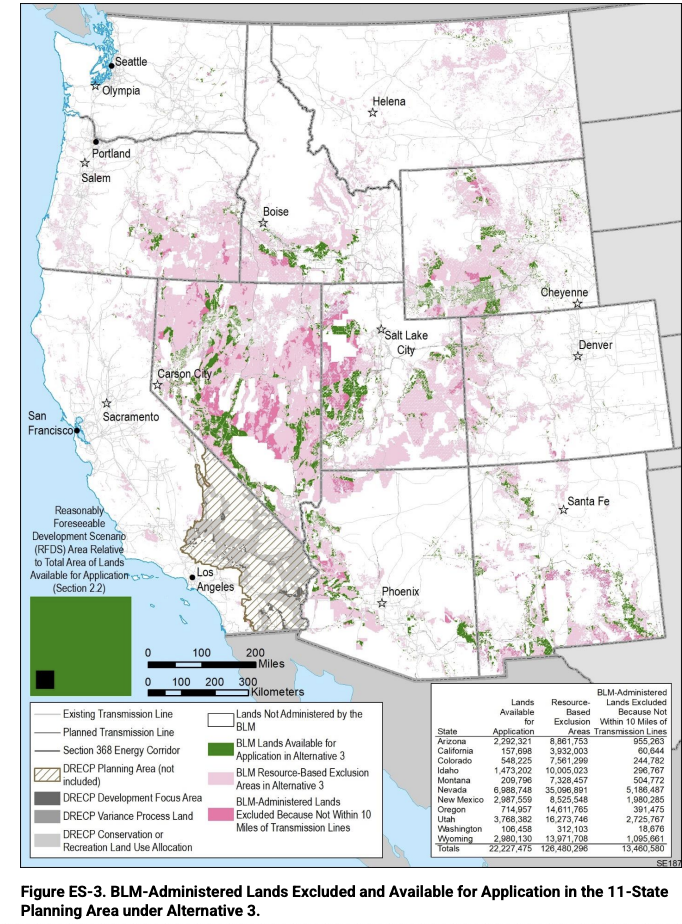
More than 20 resource-oriented criteria would preclude an area from consideration under Alternative 3. In addition to wildlife considerations — for example, the presence of big game migration corridors, greater sage grouse habitat or the presence of threatened or endangered species — such exclusionary criteria include the presence of congressionally designated Wild and Scenic rivers or Scenic or Historic trails. Sites of cultural significance to Native American tribes are also excluded.

Other proposed alternatives in the draft plan dial up or down the emphasis on the following considerations: resource-based concerns, transmission proximity, use of previously disturbed lands, and slope. (Land with a slope of 10% or greater is more susceptible to erosion.)
The Western Solar Plan does not include detail at the project level. Rather, it’s designed to be a “macro-scale programmatic land use planning effort [that] will provide a framework for making those decisions in a systematic and consistent way.”
In February, the agency hosted a public scoping session in Billings to garner input on the expansion of the Western Solar Plan into Montana, Idaho, Washington and Oregon. Some attendees expressed support for the plan and renewable energy development generally, while at least one individual voiced opposition to the use of subsidies to incentivize renewable energy development on BLM land. Other attendees focused their comments on a preference for the use of local laborers to build new solar projects and requests that the agency consider recreational land uses and big game winter habitat while drafting the plan.
The agency is accepting public comment on the Western Solar Plan through April 18, and aims to have a final plan on the books by the end of the year.
LATEST STORIES
Yellowstone County Attorney Twito resigns, tapped to lead U.S. Attorney’s Office for the District of Montana
Longtime Yellowstone County Attorney Scott Twito is stepping down to lead the U.S. Attorney’s Office for the District of Montana.
Groups sue PSC for refusing to consider climate change
Montana’s Public Service Commission rejected a petition asking the agency to consider climate impacts. Now the petitioners have sued.
Turning blank walls into big art
PLUS: MSU celebrates new nursing building, in Missoula.
