


Come January, former Billings schoolteacher Elsie Arntzen will close out a 20-year career in Montana state politics. As the six-term Republican lawmaker and two-time congressional primary contender prepares for the end of her second and final term as Montana’s superintendent of public instruction, the task now falls to voters to name one of two seasoned education leaders as her successor.
So far, that race has been relatively quiet, overshadowed by record-shattering spending in the U.S. Senate contest and a blizzard of glossy mailers currently choking mailboxes with messaging on a trio of proposed constitutional amendments. Democrat Shannon O’Brien and Republican Susie Hedalen have largely sought to cut through the noise with yard signs and personal appearances, each touting a distinctive resume in relation to the state’s K-12 public school system while avoiding all but the most veiled political barbs.
As MTFP reported last week, the Office of Public Instruction one of them stands to lead looks far different today than at the start of Arntzen’s tenure. More than 260 employees have left the agency over the past eight years, taking with them a wealth of institutional knowledge about the ins and outs of school funding and oversight. An estimated 64% of OPI’s current staff work remotely, from all corners of the state, and educators at the local level continue to report challenges obtaining timely assistance with matters related to teacher licensing and school accreditation.
Combined with recent high-profile clashes between the Arntzen administration and state lawmakers and the cavernous sociopolitical divide over public education across America, the backdrop coloring this particular race belies the low-key way in which it has so far played out. But in separate interviews with MTFP, O’Brien and Hedalen both said their most pressing challenge on day one will be to address OPI’s documented weaknesses without further disrupting the staff.
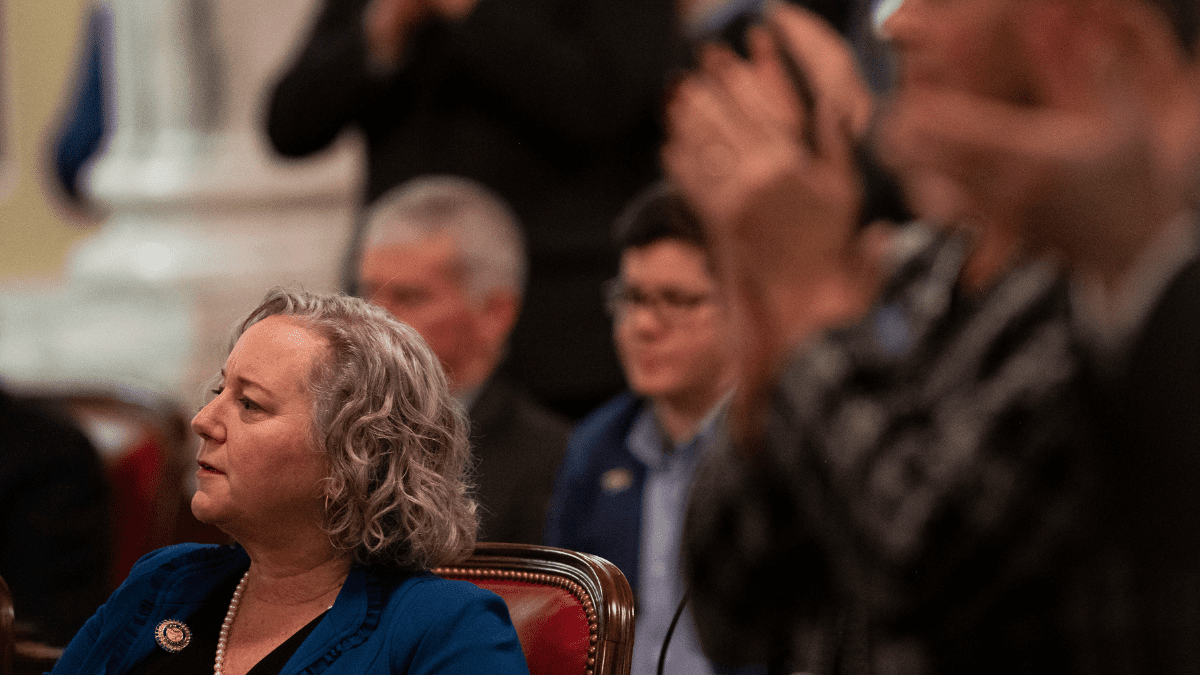
“It’s just going to be really important to have a strong transition plan in place and a team built of experts so that you’re ready to go to work,” Hedalen said.
O’Brien put it more pointedly: “The first and the biggest challenge will be to rebuild the Office of Public Instruction.”
Both candidates agree that doing so will require finesse: a deliberate, organized approach to evaluating the office’s telework arrangements, an emphasis on experience and leadership when filling its vacancies, and a robust presence in legislative policy discussions affecting its work. That last agenda item signals a marked departure by O’Brien and Hedalen from Arntzen’s aversion to OPI boosterism at the Legislature and speaks to the trajectories that brought each candidate to the Nov. 5 ballot.
Over the past two legislative sessions, O’Brien has already put her fingerprints on education policy as a state senator from Missoula. She successfully carried bills in the 2023 Legislature to expand teacher eligibility for college loan assistance and to reshape how Montana measures K-12 student proficiency. O’Brien also forged ties last year with a coalition of House Republicans aspiring to deep bipartisan education reform, agreeing to champion their proposed early childhood literacy program in the Senate.
“During the legislative session, and during the interim, I will maintain those relationships,” O’Brien said. “I will build on and maintain those relationships with legislators and other stakeholders to ensure that education continues to be a priority for all Montanans and all Montana legislators.”
In leaning on an existing legislative network, O’Brien intends to help move the needle on specific policies impacting public school budgets and, by extension, the state’s crushing teacher shortage. Top on her list of policy targets is increasing the inflationary adjustment lawmakers apply to state education funding, long held to a 3% cap, followed closely by potential expansions of payments tied to licensed full-time teachers and of state-backed loan assistance for new educators. O’Brien said she also plans to explore public-private partnerships built around incentives for high school and college students to enter the teaching profession.

Elsie Arntzen’s OPI
Elsie Arntzen eased into leadership of the Office of Public Instruction in 2016, marking a fundamental shift at the top of Montana’s education hierarchy. For nearly 30 years prior, the post had been held by the political left. Arntzen will close out her second and final term on Dec. 31, handing the reins of Montana’s K-12 school system to a successor to be determined Nov. 5. Before voters choose a new state superintendent, there’s a question to answer: How has OPI — and, by extension, public education in Montana — changed over the past eight years?
Hedalen similarly points to the state Capitol as an arena in which she’s built significant inroads, most recently through her appointment by Republican Gov. Greg Gianforte to Montana’s Board of Public Education, where she now serves as vice chair. Her campaign has netted endorsements from an array of Republican lawmakers including Rep. Sue Vinton of Billings, who chaperoned 2023’s two successful school-choice bills, and Sen. Dan Salomon of Ronan, who sided with Senate Democrats in resisting both. But it’s her experience in the field as a licensed teacher and administrator in districts throughout Montana since 2007 that Hedalen suggests will give the most heft to her advocacy on legislative issues.
“I don’t know if there is a way to make sure that legislation is ever 100% perfect, because there’s always going to be a circumstance that arises that maybe no one could have foreseen when the bill was being written. And we have incredibly smart legislators that do their best,” said Hedalen, who is also the current superintendent of the Townsend School District. “However, without having someone with the administrative-level experience of implementing these bills in schools, I think we see more and more issues.”
Hedalen recalled bringing that perspective to bear during the 2017 Legislature when, as a newly minted educational services director at OPI, she worked with lawmakers to improve suicide prevention training laws for educators. Cognizant of local concerns about liability for teachers who took such training, Hedalen said she looked to other states for inspiration and helped lawmakers add a “hold harmless” clause to Montana law. More recently, she noted that she and other district officials have been frustrated by difficulties with OPI’s new accreditation system and the office’s slow pace in upgrading Montana’s statewide education database, issues she hopes to make progress on if elected next month.
The in-the-halls experience Hedalen claims as her key strength also fuels her most common critique of O’Brien. Citing O’Brien’s legislative tenure and her work as an education policy adviser to former Democratic Gov. Steve Bullock, Hedalen characterized her opponent as someone more familiar with politics and policymaking than with the challenges local educators and administrators face every day.

It’s a framing O’Brien has been quick to counter on the campaign trail, referencing her years as a social studies teacher in Washington state as well as her two-year stint as dean of Missoula College. O’Brien — who has the endorsement of former Democratic state superintendents Denise Juneau, Linda McCulloch and Nancy Keenan — doesn’t necessarily share Hedalen’s view of the office as a statewide parallel to local administrator posts, describing her role, if elected, as “chief liaison” between local school leaders and state government. And as the mother of a Montana public school student, O’Brien said, she’s keenly aware of the day’s pressing issues.
“Every child needs to be safe when they go into school,” O’Brien said. “This is personal for me. I’ve got a boy at Hellgate High School. We had a lockdown the first week of school. We need to address that issue head-on.”
O’Brien and her supporters have likewise painted Hedalen as the out-of-touch candidate, attempting to tether her to Arntzen’s embattled administration by virtue of her roughly year-long stint in 2018 and 2019 as Arntzen’s deputy superintendent and her Arntzen-esque campaign rhetoric about keeping “indoctrination” out of public classrooms.

Hedalen rebuffs such characterizations, saying she was hired to OPI based on professional qualifications that include a graduate certificate in Native American studies and two years overseeing federal programs and associated funding for the Livingston School District. She added that she didn’t know Arntzen prior to joining the agency, and shares the concerns expressed by Republicans and Democrats alike regarding OPI’s recent struggles.
“My work in education speaks for itself,” Hedalen said. “I support students and have done a very successful job without political controversy in any of the communities that I’ve served in.”
As overshadowed as the race between O’Brien and Hedalen has been, both candidates appreciate the significance of the office they’re vying to enter. The state funding, programs and regulations OPI administers touch the lives of some 149,000 students and 16,000 educators in more than 800 schools throughout Montana. Lawmakers are already crafting new education proposals for the 2025 session, and advocates from across education’s cultural divide are lining up to advance their own agendas. The end of the session, come spring, will quickly give way to a legally mandated 10-year review of Montana’s education funding formula, a critical milestone in resolving long-term worries about adequate financing of the K-12 system. Whether Montana voters decide to return OPI to Democratic leadership under a former teacher turned seasoned lawmaker or retain Republican control with a tested local administrator and state board leader, addressing internal challenges at the agency will be only the beginning of the job.
This story was updated Oct. 18, 2024, to correct an erroneous attribution of two 2023 school choice bills to Susie Hedalen.
LATEST STORIES
Federal judge blocks Montana’s AI campaign ad law
A Montana law regulating the use of generative artificial intelligence in campaign ads has been dealt a blow by a federal judge based on freedom of speech concerns. The order greenlights general election advertising that former legislator Dan Bartel and ASG PAC planned to use, but feared being prosecuted for.
Montanans are using AI, but remain wary of its societal impact
Almost four years after OpenAI’s release of ChatGPT, AI is now firmly rooted in many Montanans’ day-to-day tasks, according to a Montana Free Press-Eagleton poll of registered voters conducted in late August and early September. More Montanans use AI — and to some extent trust AI — for general searches, work tasks and writing, than for more intimate functions, like medical advice or companionship. Users remain skeptical of the technology’s broader impacts, too. Only about 12% believe AI has a “somewhat” or “very positive” impact on society.
Broadview area data center sees first phase of construction with roads, well work
Quantica has agreed to use local, unionized labor when possible, under a memorandum of understanding it signed with the Southeastern Montana Building and Construction Trades Council. Riley McCauley, vice president of the council, said they won’t have details on job numbers or wages until Quantica has secured an “end user,” or a digital or AI company, to purchase the facility.
