


Get an insider’s look into what’s happening in and around the halls of power with expert reporting, analysis and insight from the editors and reporters of Montana Free Press. Sign up to get the free Capitolized newsletter delivered to your inbox every Thursday.
September 17, 2026
Montana lawmakers trying to get to the bottom of what state voter information was shared with the federal government say they still have questions, despite a subpoenaed response from Montana’s secretary of state.
Legislators on the Interim State Administration and Veterans Affairs Committee had subpoenaed Secretary of State Christi Jacobsen for the subject headers of a Montana voter file Jacobsen’s office shared last year with the U.S. Department of Justice.
Jacobsen’s staff responded Sept. 11 with a letter saying, “the subpoena was an unnecessary encroachment of the separation of powers that wasted taxpayer dollars, could have been avoided and lacked warranted scrutiny.”
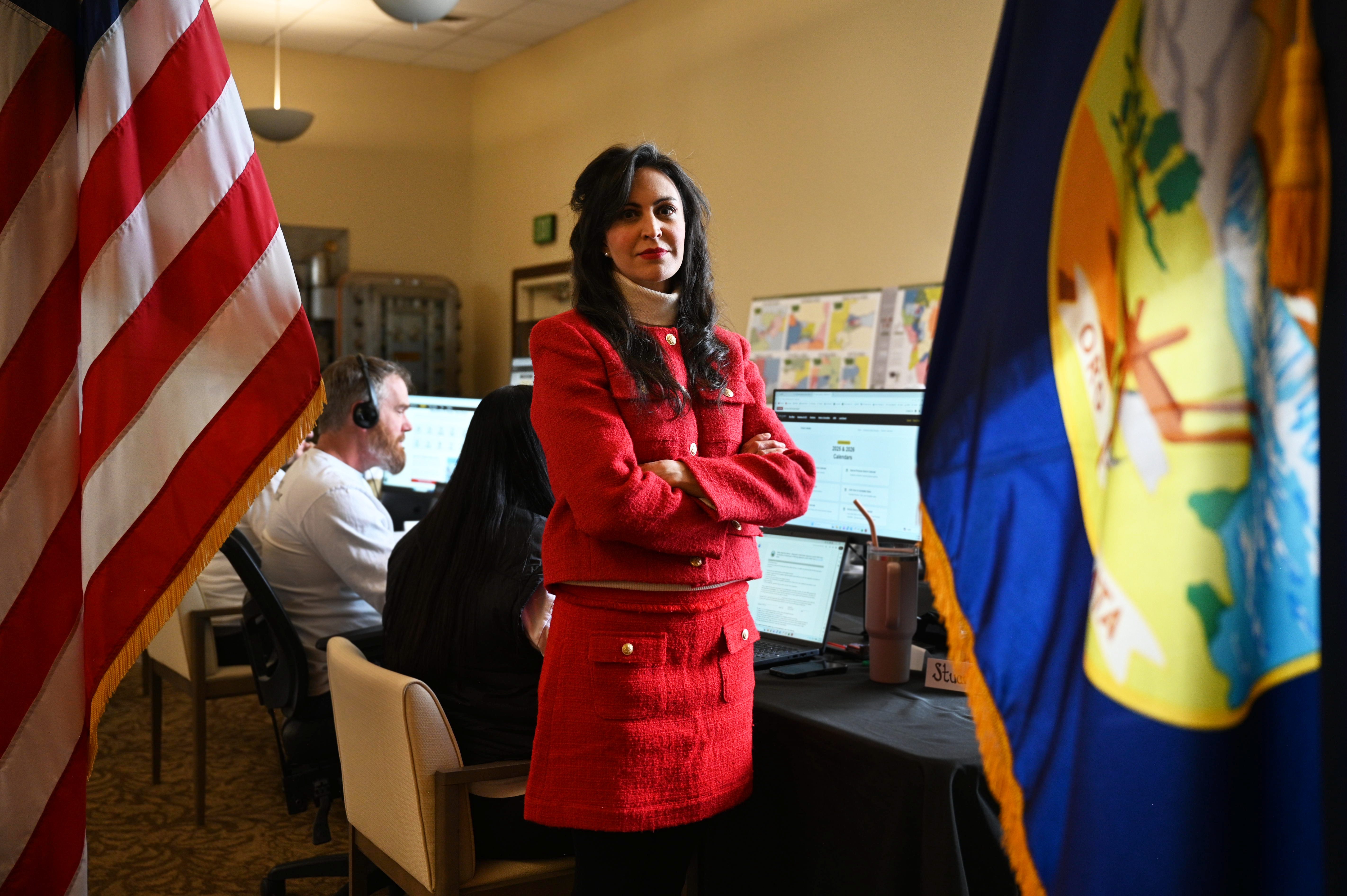
In a hand-delivered letter, Austin James, the secretary of state’s legal counsel, told lawmakers they could have gotten the information from other sources, including the Legislative Audit Committee, which questioned James about shared voter data last spring.
SAVA Committee Vice Chair Rep. Marc Lee, D-Butte, told Capitolized that he and Chair Sen. Theresa Manzella, R-Hamilton, met Monday with legislative attorneys who advised that although Jacobsen didn’t produce the subpoenaed information in the spreadsheet format legislators expected, the requested details were written into the response authored by James.
For some percentage of Montana voters, the data shared with the federal government included the last four digits of the voters’ Social Security numbers, which James said served as a substitute for a driver’s license number for voters who didn’t use a driver’s license to register to vote.
“You have to deduce it a little bit when you read the letter,” Lee said of locating the details responsive to the subpoena. “There’s like six or seven things in there that if you scrounge through the letter you can find.”
A U.S. Department of Justice demand in August 2025 for Montana voter records, complete with birth dates, driver’s license numbers and partial Social Security numbers, is at the core of the legislators’ questions. On Sept. 14, that personally sensitive information became the subject of a federal government whistleblower report alleging that U.S. Department of Homeland Security investigators used the data to log into public-facing state websites to access individual voter histories.
The whistleblower report became public when U.S. Senate Democratic Leader Charles Schumer, D-New York, and Sen. Alex Padilla, D-California, presented its findings to DHS Secretary Markwayne Mullin and demanded a response by Sept. 21.
The report was sourced to the Democracy Defenders Fund, a nonprofit watchdog.
Neither Lee nor Manzella was familiar with the report before talking to Capitolized. Discussions in the legislative committee led by the two lawmakers hadn’t produced an answer to why the U.S. Department of Justice would want voters’ partial Social Security numbers.
Manzella, at the committee’s Sept. 2 meeting, said the Social Security data was shared with the U.S. DOJ “for the obvious reason that Social Security numbers are issued by the federal government.”
Thursday, Manzella said the government needed the partial Social Security numbers to positively identify voters. Both Manzella and Jacobsen support President Donald Trump’s efforts to identify non-citizen voters. Trump, without verification, credits his 2020 presidential loss to non-citizen and deceased voters. In a July address to the nation, Trump claimed that thousands of non-citizens are registering to vote.
States have primary authority over elections under the U.S. Constitution. More than two dozen states have been sued by the U.S. Department of Justice after refusing to provide voter information, citing privacy rights and arguing that U.S. DOJ has no right to the data. Twenty-three of those cases have been dismissed by federal courts in favor of the states so far.
Manzella told her committee Sept. 2 that Jacobsen spared Montana from a lawsuit by cooperating with the U.S. DOJ. Jacobsen led her response to the subpoena this week by offering a truncated Manzella quote:
“I have to respect our Secretary of State is wanting to stand and protect states’ rights. I know the [Trump] administration has sued states that have not complied with their requests and we have not been sued. … Our Secretary of State is doing her best to protect states’ rights and our citizen[s] thereof, and walking a fine line and honoring the federal laws…”
Manzella told Capitolized she will work in the Legislature to make it easier to prevent non-citizens from voting, an effort she worked on in 2025 with mixed results.
Committee member Rep. Kelly Kortum, D-Bozeman, said he will pursue stronger voter protection laws in the next legislative session to ensure that voters know if their information is being shared.
“Lawmakers set state election laws and the safety of voter information. So there definitely could be a privacy-protection law,” Kortum said. “We need to reaffirm that in the code to assure that Montanans know what’s happening with their information.”
—Tom Lutey
Shedding Primary Colors
Right out of the gate, Montana’s western congressional candidates were touting their national endorsements.
Aaron Flint, the Republican nominee for Montana’s Western U.S. House District, mentioned his endorsement by President Donald Trump at the top, center and bottom of this campaign website. The president, who fancies his endorsement as a Midas touch, had posted his approval of Flint on Truth Social in March, not long after the war veteran and conservative talk radio host made his campaign official.
Sam Forstag, the Democrat running against Flint, was touting his Bernie Sanders bona fides with his endorsement by the independent senator from Vermont on his website, along with a handful of others from lawmakers like Maryland Rep. Jamie Raskin, who managed the second impeachment of Donald Trump in February 2021.
Those endorsements, useful distinctions as Flint and Forstag campaigned in multi-candidate primaries, no longer dominate their websites.
The endorsements now front and center on Flint’s homepage feature hard-hat-wearing members of a local carpenters union and the Montana Contractors Association. Forstag’s endorsement page is mostly a patchwork quilt of union logos and Montana legislators.
The center of the political spectrum is where the swing voters are, said Jeremy Johnson, head of the political science department at Carroll College. The race for Montana’s Western District is statistically tied.
“Sometimes candidates are trying to speak to the base, but I think in this race they’re going to find the true swing voters,” Johnson said.
Those swing voters are likely to be the least engaged and located in the center, he said.
Also, Trump has become a repelling force for Republicans in tight races, he said.
Trump’s favorability rating has decreased among Montana’s registered voters in 2026, dropping from 47% in May to 40% in September, according to Montana Free Press-Eagleton polling.
In the most recent MTFP-Eagleton poll, 45% of registered voters said a Trump endorsement made them less likely to vote for a candidate. Another 23% said it made them more likely to vote for a candidate. About 31% said it had no effect.
Unsurprisingly, Democrats were more likely not to support a Trump-endorsed candidate. Among Republicans, 44% said a Trump endorsement made them more likely to vote for a candidate, and 47% said it would have no impact.
Among independent voters, only 2% said a Trump endorsement made them more likely to vote for a candidate, while 59% said it made them less likely.
—Tom Lutey and Zeke Lloyd
Miller Times Out
Brian Miller, a Helena attorney running as a Democrat in the Eastern District House race, announced on Facebook this week that he is dropping a lawsuit that asked a judge to consider disqualifying hundreds of signatures that allowed independent candidate Michael Eisenhauer to qualify for the ballot. District Court Court Mike McMahon dismissed the case Tuesday at Miller’s request.
“I just realized I just got too much going on,” Miller told Capitolized Thursday.
To have any signatures removed, Miller was relying on Cascade County law enforcement to find fraud in its ongoing investigation of about 800 potentially bogus signatures. As of publication, law enforcement has not publicly identified even one forged signature. The signatures that Cascade County is investigating were not among the signatures used to qualify Eisenhauer for the ballot.
Signatures are submitted in batches. Each batch is accompanied by an affidavit, a binding legal document signed by the gatherer that attests to the signature’s validity.
The main thrust of Miller’s lawsuit argued that one fraudulent signature should invalidate the affidavit of an entire batch, and so every batch that contains a fraudulent signature should be disqualified in whole. That could have invalidated about 1,600 signatures from Eisenhauer’s petition, which would have put the independent candidate below the threshold to qualify for the ballot.
Cascade County Attorney Josh Racki confirmed Thursday that law enforcement’s investigation is ongoing.
— Zeke Lloyd
The Bottom Line
The line that will appear at the bottom of the general election ballot for Montana’s U.S. Senate race could be getting some exercise, according to the latest round of polling by Montana Free Press.
The line belongs to Jami Woodman, who as Montana’s only official write-in candidate is the only person write-in votes will be considered for. The line was added specifically for Woodman.
Roughly 6% of registered voters indicated in the MTFP-Eagleton Poll that they won’t vote for the Democrat, independent, Libertarian or Republican candidate. Libertarian Kyle Austin’s polling share was only 5%.
Woodman is a veteran campaign worker who has appeared on the campaign finance ledgers of U.S. Senate races in 2020 and 2026 as a paid campaign strategist, having worked for both Democrats John Mues and Reilly Neill. She’s also been a volunteer doing a little bit of everything.
Jeremy Johnson, political science department head at Carroll College, is skeptical that the voting booth pens of “none-of-the-above” voters will land on the ballot’s blank write-in line. Voters want to choose between one named person and another, he said.
— Tom Lutey

