This story is excerpted from the MT Lowdown, a weekly newsletter digest containing original reporting and analysis published every Friday.
It’s the time of year when it seems like everybody and their dog is hitting the road for summer trips, so we thought we’d take a look at which stretches of Montana highway rank as the busiest.
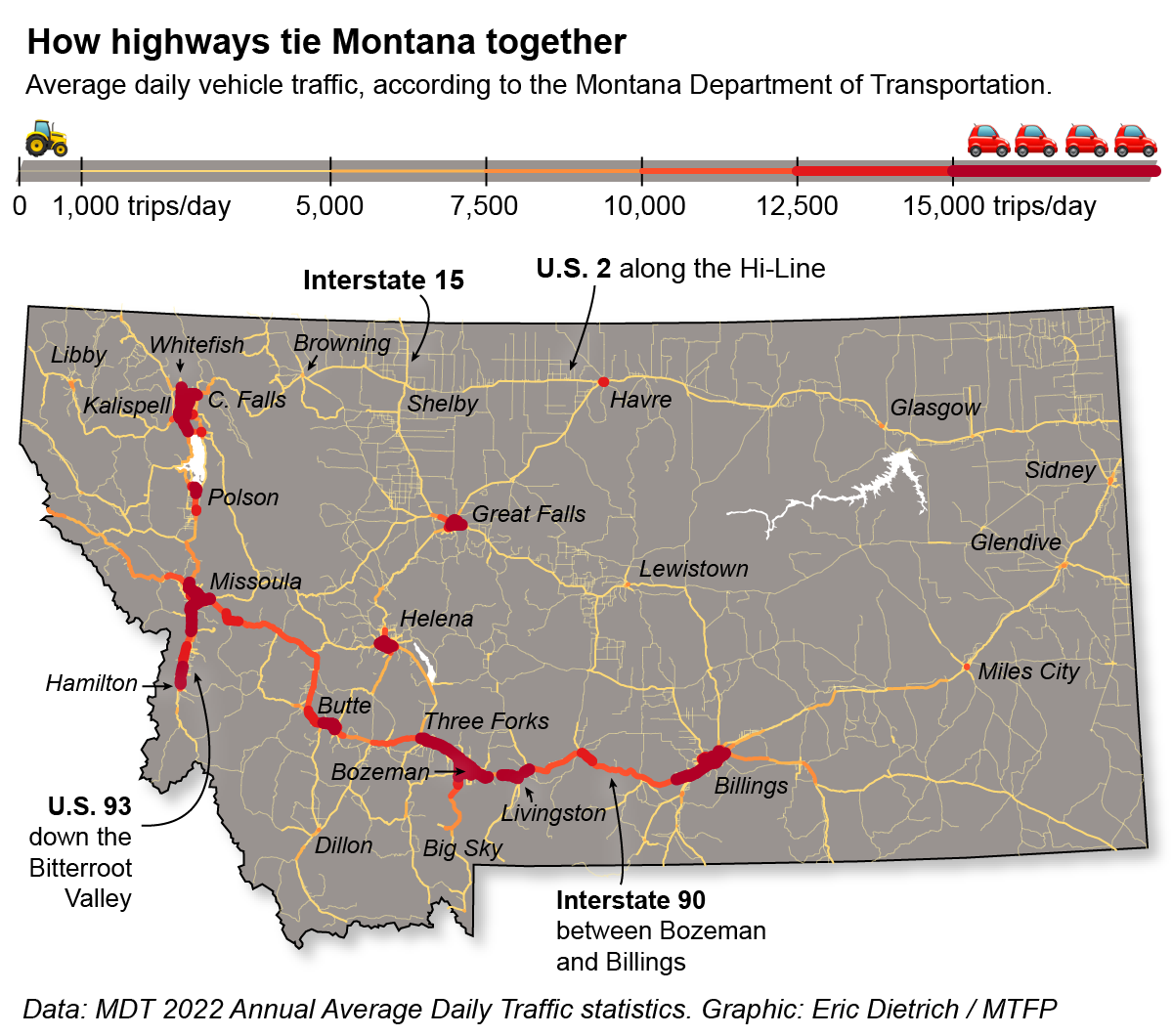
As it turns out, according to data from the Montana Department of Transportation, the state’s highway hot spots tend to cluster around urban areas. A stretch of King Avenue West in Billings just north of Interstate 90 has the dubious distinction of being the busiest road in the state, with about 40,000 vehicle trips a day. Other busy spots include the city’s Main Street as it heads into Billings Heights from downtown, at about 39,000 trips a day, and a stretch of 10th Avenue South in Great Falls that averages nearly 37,000 trips a day. Stretches of North Reserve Street in Missoula also rank high on the list, averaging about 36,000 daily trips.
Outside city limits, heavy traffic flows clump around common commuter paths — in the Kalispell-Whitefish-Columbia Falls triangle, for example, as well as around Bozeman and down the Bitterroot Valley from Missoula. The stretch of U.S. 93 between Missoula and Lolo sees about 26,000 vehicles a day on average.
I-90, the east-west route that stretches across the nation from Seattle to Boston, sees heavy traffic as it crosses Montana, especially from Missoula through Billings. West of Bozeman, between Belgrade and Manhattan, for example, I-90 sees about 19,000 vehicle trips a day. MDT also estimates that about 11,000 vehicles a day cross the Continental Divide via Homestake Pass just east of Butte.
Interstate 15, which runs from the Canadian border through Shelby, Great Falls, Helena, Butte and Dillon en route to southern California, is, by comparison, lightly trafficked on its Montana traverse. As it passes Cascade, between Helena and Great Falls, for example, I-15 carries a relatively light load of 4,300 vehicles a day.
Those figures, currently available for 2022, are what the highway department calls Annual Average Daily Traffic statistics, figures intended to represent typical traffic volume. The department uses monitoring systems to collect travel data year-round on some roadways and extrapolates from “snapshot” counts to estimate vehicle volume on others.
Because the numbers are year-round averages, they may underestimate how much traffic certain stretches see on, for example, the Friday before a summer holiday weekend. Conversely, the numbers probably overstate how much traffic roads see on winter days when poor weather encourages drivers to stay home — at least on routes that don’t lead to ski resorts.
Interested in exploring an interactive version of this data? A zoomable map that makes it easier to see the counts for specific roads in your part of the state is available on the transportation department’s website.
LATEST STORIES
Senate leaders announce plan to investigate sexual misconduct allegations against longtime legislator Jonathan Windy Boy
Republican and Democratic leaders in the state Senate have announced a plan to address allegations of sexual misconduct against Sen. Jonathan Windy Boy, D-Box Elder. The Senate president and minority leader said they plan to refer the issue to the Senate Ethics Committee for investigation when the Legislature convenes in January.
As federal employees disappear, Red Rock Lakes is struggling
Sources are saying the wildlife refuge system has lost as much as 36 percent of its workforce since January 2025. This GYE refuge is feeling the pinch.
Floppy disks and paper strips: How Montana’s air traffic system fared in the FAA ground stop
The technical problems began around 1:30 p.m. Mountain Time on Nov. 13. About 25 minutes later, U.S. airports experienced the most sweeping halt of departures since Sept. 11, 2001. Air traffic resumed at 6:15 p.m. Nov. 13, but not before the MSU Bobcats delayed a game in Colorado, and Montana’s antiquated air traffic infrastructure was exposed.