
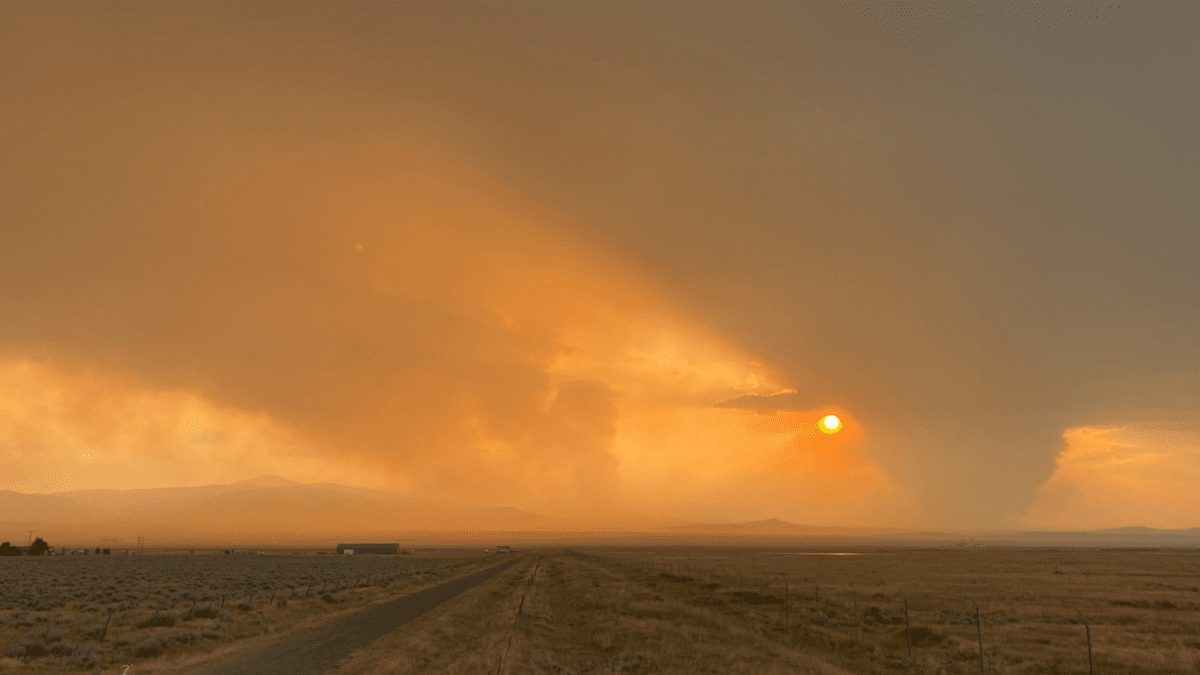

When teachers, nurses and coaches call to ask about air quality in their rural Montana school districts, staff at the Department of Environmental Quality sometimes feel limited by the information that’s available from the current network of regulatory sensors scattered around the state.
“That just doesn’t feel good enough,” DEQ’s Air Research and Monitoring Supervisor Kelly Dorsi said. “So when we had the opportunity to apply for this Advanced Monitoring for Communities Grant as part of the American Rescue Plan and the Inflation Reduction Act, we jumped at the opportunity.”
In November 2022, DEQ announced the PurpleAir in Schools Program, an initiative to install a system of air quality monitors in public high schools. With the arrival of substantial federal funding in June 2023, DEQ began coordinating installations.
“In the first year of the program, we’ve recruited 98 high schools. Of those, 30 schools have sensors online and [are] reporting data publicly on the EPA’s AirNow Fire and Smoke map,” Dorsi said. Another “fifty-four schools physically have their sensors, but they are not online, and 14 schools are in the process of getting approval from their administrators.”
The new sensors aren’t as accurate as the regulatory monitors that make up the current Montana network. But because of gaps in that system, color-coded maps indicating Air Quality Index readings are forced to estimate AQI figures for under-monitored — often rural — regions. According to Dorsi, the PurpleAir in Schools Program can provide information specific to those communities. When adjusted in accordance with a corrective algorithm, sensors with the PurpleAir system indicate the correct color-coded AQI category 91% of the time.
“This is all about filling in those gaps and getting data to the public,” Dorsi said.
Robust additions to Montana’s network of public health information help contribute to healthy fire season decisions. Reliable resources to answer questions about the impacts of heat and haze can mean the difference between stressing over gloomy, unhealthy summer smoke and breathing easy in the comfort of a good safety strategy.
WHAT’S IN SMOKE?
Smoke contains the products of both complete and incomplete chemical combustion. Some of smoke’s most infamous components come in the form of gasses, including carbon monoxide, sulfur dioxide and nitrogen oxides. But smoke’s subtler scourge is particulate matter: tiny liquid and solid molecules that hang suspended in smoky air. In its most dangerous form, categorically referred to as PM2.5, these particles and droplets are only two and a half micrometers in diameter or less. Their size enables them to escape entrapment by nose hairs that function to filter out unhealthy particles, said Tony Ward, chair of the School of Public and Community Health Sciences at the University of Montana.

HOW DOES SMOKE IMPACT THE LUNGS?
Inhaling the harmful gasses contained in wildfire smoke can lead to headaches, dizziness, shortness of breath and, in the long term, respiratory and cardiovascular disease. Meanwhile, PM2.5 sinks deep into the lungs and, because it’s so small, can dissolve into the bloodstream. People with pre-existing lung or heart conditions are at particular risk for hospitalization or early death after a month of sustained wildfire smoke.
After the 2017 Rice Ridge Fire in Seeley Lake, researchers followed members of the Seeley Lake community for two years to assess the impact of heavy wildfire smoke on human health. Up to two years after the fire, researchers found a significant decrease in lung function. A study out of the University of Montana found that higher PM2.5 concentrations in the summer are positively correlated with an increase in flu the following winter.
WHERE CAN I FIND INFORMATION ON MONTANA’S AIR QUALITY AND TEMPERATURES?
DEQ’s Today’s Air website and the Environmental Protection Agency’s AirNow both post up-to-date information about air quality. Both databases present sensor data from specific monitoring locations and report air quality ratings based on PM2.5 readings. Montana Free Press also summarizes data from AirNow onto the Montana Fire Report, which is updated hourly.
DEQ also offers an email or text update system that alerts users to smoke and wildfires. The Montana Wildfire Smoke web page from Climate Smart Missoula provides guidance on understanding the health impacts of wildfire smoke and making a plan to keep indoor air clean.
The National Weather Service’s Statewide Weather Information website updates a map of Montana with high-temperature alerts by area.
IS IT BETTER TO STAY INSIDE?
In the context of air pollutants, the EPA has found that indoor air may be worse than outdoor air. But keeping a house cool is important during periods of high heat, introducing a delicate balance between air quality and temperature.
Opening windows to cool a house on a smoky day can allow smoke into the living space. Even air conditioners that bring outdoor air inside to cool can circulate harmful particles.
Ward said having a filter on any A/C intake may help scrub out PM2.5. Alternatively, if a central A/C unit has a fresh air intake, set it to recirculate mode — that way, the A/C will draw air from inside the house, cooling it and recirculating it. Recirculation is an option for vehicles with air conditioning, too.
Installing air purifiers in every room or rigging a box fan to act as an air filter can minimize the presence of harmful particles. Air purifiers are rated based on filter size and matched to appropriate room size. If a home only has one air filter, the best option is to create a clean-air space in a room where the family spends the most time, according to Ward.
The state health department provides information on how to choose an appropriate HEPA filter and a weatherization assistance program. The Montana Asthma Home Control program also provides free small HEPA filters to people with asthma.
Missoula City-County Air Quality Specialist Sarah Coefield said people may need to make judgment calls between managing heat or smoke, especially if they don’t have access to air conditioners or air purifiers. She advised letting in as much air at night as tolerable to cool down the house and cleaning it through whatever system is available. Coefield, who doesn’t have central A/C, said that she uses air purifiers and a window A/C unit in her bedroom; she knows she has at least one cool, clean space to retreat to.
IS OUTDOOR RECREATION SAFE DURING FIRE SEASON?
When wildfire smoke fills the air, there is no way to avoid its health impacts entirely. In addition to the dangerous gaseous compounds it introduces, inhaling PM2.5 is “very harmful for your body not only [in the] short term, but also long term,” Ward said. Harmful effects include breathing problems, exacerbated asthma, cardiovascular diseases and even lung cancer.
Cloth and surgical masks aren’t effective against PM2.5, though N95 and P100 respirators can work if they’re properly fitted and used correctly.
Enjoying the outdoors during fire season is about strategy and assessing personal risk.
LATEST STORIES
Montana judge blocks education savings accounts for students with special needs
A Montana district court judge has blocked House Bill 393, the Students with Special Needs Equal Opportunity Act, halting the state’s first education savings account program. The decision found the Legislature failed to make a lawful appropriation for the program, which would have allowed parents of students with disabilities to redirect per-pupil funding to private schooling, tutoring, therapy or online classes. Other claims remain unresolved and could proceed to trial if appealed.
After two years of controversy, state health department restores key tribal role
Two years after the state health department controversially eliminated a position that tribes in Montana said was critical to their voices being heard, the role has been restored.
Paradise Valley open space initiative falters amid political priority reversal
In the waning days of the Biden administration, Gallatin Valley Land Trust received $25 million to build on a conservation easement program’s initial success. However, in the summer of 2025, the federal government informed the land trust that the funding had been rescinded, throwing a wrench in an open-space preservation program that had been gaining momentum in Park County, where nearly 40,000 acres of land has been developed since 2000.