


The MT Lowdown is a weekly digest that showcases a more personal side of Montana Free Press’ high-quality reporting while keeping you up to speed on the biggest news impacting Montanans. Want to see the MT Lowdown in your inbox every Friday? Sign up here.
The summer storm that crashed down on Missoula suddenly Wednesday evening turned the cityscape outside my third-floor window into a Mad Maxian cloud of wind-borne dust and debris. What first struck me as I glanced up from the couch was the color: a sickly orange haze, which quickly swallowed the neighboring rooftops. In seconds, gusts began savaging the side-yard maple tree, beating it against the house. I rushed outside just in time to hear the transformer in the alley pop as wind deposited a massive branch on top of it from what I can only guess was the next county over.
As the lights blinked out, the sirens came on.
Throughout the night and into the morning, thousands of residents across western Montana went without power. (As of Friday, some Missoulians are still making their morning coffee on propane campstoves.) Emergency services were inundated with hundreds of calls. Sunrise brought a clearer picture of the damage — streets littered with downed trees and powerlines, street lamps standing lightless — as well as more information on what had transpired.
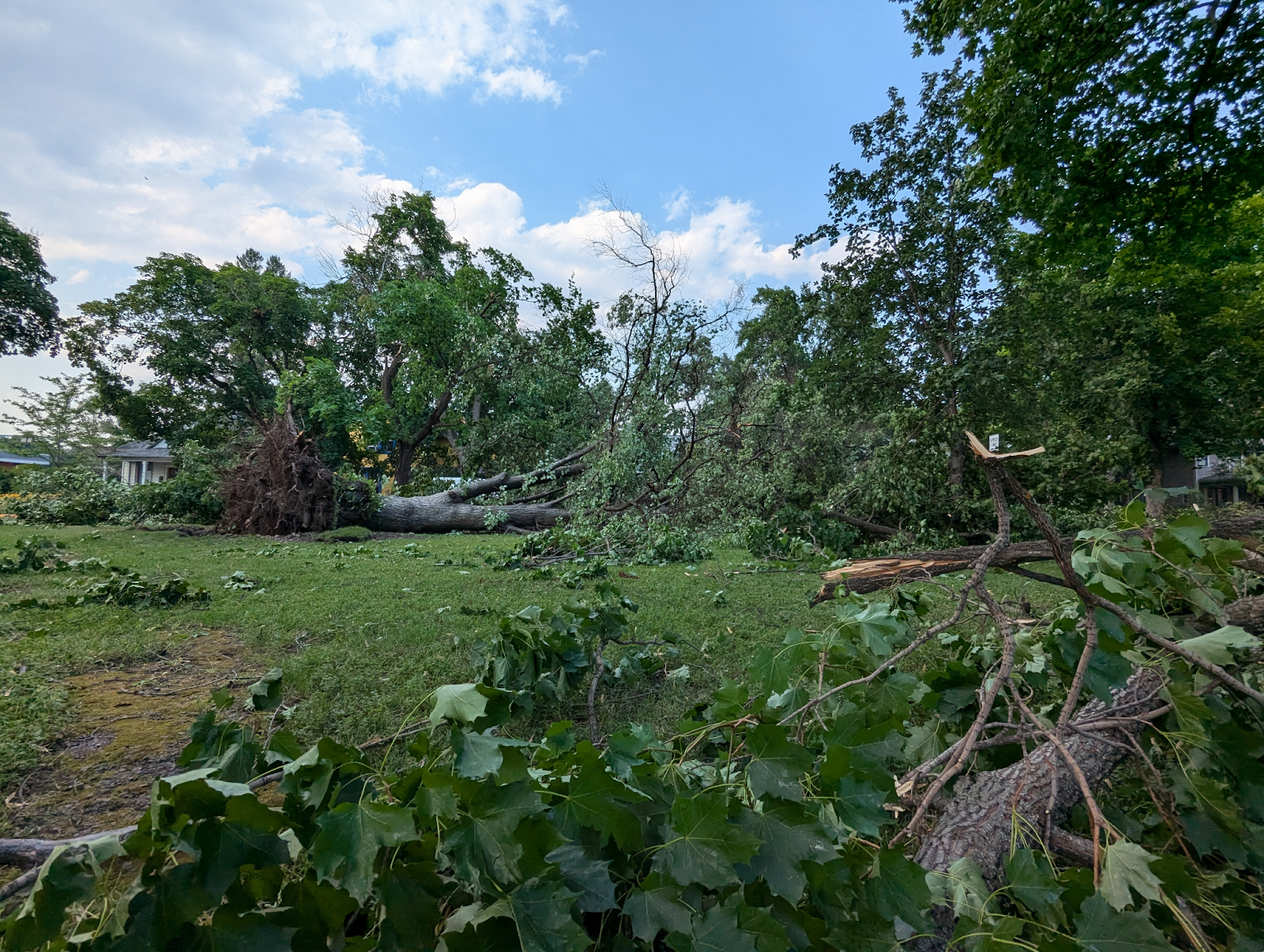
Wednesday was already two weeks in to a statewide heatwave, which has seen the growth of numerous wildfires and multiple days of temperatures topping 100 degrees Fahrenheit. But the western Montana storm added rain and lightning into the mix, along with wind gusts that registered as high as 109 mph at the top of Mount Sentinel, according to the National Weather Service. The regional forecast ahead of the storm was severe enough that NorthWestern Energy had already discussed the possibility of planned power outages to keep its equipment from sparking fires in wildfire-prone areas around Bozeman, Butte, Helena and Great Falls. The utility’s contemplated list did not include the region hit hardest by the Wednesday night storm, which stretched from St. Regis to Hamilton.
In social media posts, Missoula County officials encouraged people to check on their neighbors, especially the elderly, and to conserve water as ongoing power outages had forced local governments to use back-up generators to move water. The county also noted that the Red Cross was posted up at the Missoula County Elections Center, offering residents still lacking power access to showers, air conditioning and a charger for phones and laptops.
Around my quiet riverside block, the drone of chainsaws buzzed through the morning as neighbors worked to clear the side streets. Piles of branches clogged the boulevards. Texts rolled in from friends checking in, sharing stories about totaled cars and evening jogs cut short by the storm’s frighteningly sudden arrival. As of Thursday, no fatalities had been reported, but the full extent of the damage and the storm’s impact on Montana’s wildfire season has yet to be tallied.
—Alex Sakariassen
3 Qs For
I spent the week of July 15 in Lewistown, working out of the Lewistown News-Argus newsroom on a forthcoming story about how community leaders are working to address housing affordability and other issues as a series of economic development wins position the small central Montana town to add residents for the first time in decades.
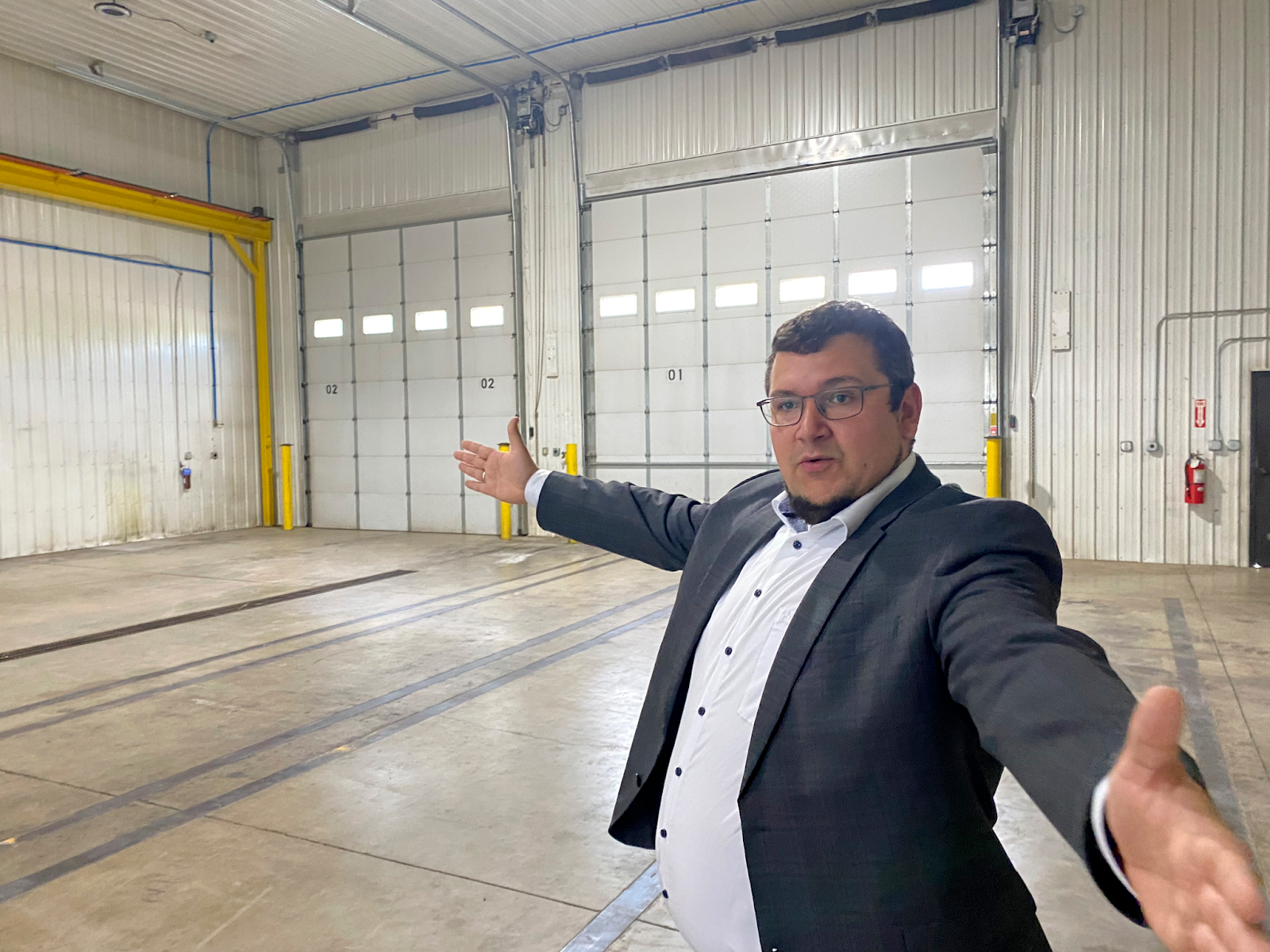
Among the key drivers of that growth was last year’s announcement that German industrial equipment company VACOM had chosen Lewistown as the site for its first U.S. manufacturing center, a development that the company has said could create 200 jobs in the 6,000-person city as soon as 2027. I spoke with VACOM Montana General Manager Marcel Klessen, who relocated his family to Lewistown earlier this summer, about the company’s plans and how it hopes to fit its operation into the rural Montana community. Our conversation has been condensed and edited for clarity.
MTFP: Could you help me understand your business?
Klessen: Our company was founded in the early 1990s and we focused on vacuum technology, everything you need for vacuum applications like channels, flanges, pumps, measuring devices and so on. We typically deliver to big machine-building companies. For example if you have an anti-reflective coating on your glass, then this glass is in a vacuum machine and we have delivered parts to the machine-building company. So it’s industrial vacuums — it’s not cleaning your living room.
In the early 2000s, there came up a new technology, UV lithography — you use that for [computer] chip manufacturing. They were the first lithography process which had to go to vacuum applications. And if you go in a vacuum, there are a lot of problems appearing, for example outgassing. If you create a vacuum, then contamination like residuals from fingerprints or from coolants, they go to the vacuum and they can then destroy your parts.
So they have to set up these high-purity applications. So, we are part of this from the beginning to go this way, starting with cleaning our own products and then moving on. And later on, we generate this cleaning service.
MTFP: I’m talking to people in Lewistown about land-use planning and culture change and how you accommodate new people, which is a challenge anywhere you have economic development. How is VACOM thinking about working with the community here to come in without changing things in a way that people perhaps regret down the road?
Klessen: We are here to work together with the community and build something together. So it’s not our aim to make our own German bubble here. We know that we have to change our way of working to the people which live here. So I can’t bring processes from Germany one by one and come to another mentality and different people and say “OK — do it that way.” We have to learn from our workforce how they can manage what has to be done and then we will be adjusting our processes. And that’s the same with the community for us. We are new here, so we have to fit in the community that’s already there.
We are trying to participate in the events here, to become slowly part of the community. That’s part of my work. We are not here for sitting in our house and not talking to anyone.
The other thing is we are not planning to bring a lot of not-Montana people here. I think it will be a good match and very helpful for us to have local people in our facility and to work together with them, so to prevent from building a bubble. We don’t plan to bring 200 people from Germany or so — that would make the task to fit in the community even harder.
MTFP: Why did the company choose Lewistown instead of someplace like Bozeman, or Las Vegas, or someplace on an interstate highway where there are a bunch of manufacturing companies around?
Klessen: It’s always tough to find the right workforce and to have them for a long time. And in communities where you have a lot of other industrial companies it’s even harder, let’s say. We are comfortable with getting people and training them on the job. We need a lot of effort to get the people to level that they can do the job in the quality we need. We like to have employees for a very long time. And so we decided to come to a community where we do not have 20 other companies who work in cleanrooms and with high-purity applications.
Klessen said VACOM’s initial step in Lewistown will be to open a cleanroom facility in an existing building previously used as a diesel repair shop, employing between 20 and 25 workers when it begins operations as soon as next year. The company then plans to add a manufacturing operation in another existing building before ultimately expanding into a custom-built campus that is currently in the planning stages.
—Eric Dietrich
Hot Potato 🥔
As a result of ongoing national litigation, Montana’s university system has directed all state campuses not to implement a federal expansion of protections against sex- and gender-based discrimination, which had been advanced by the administration of President Joe Biden and was set to go into effect Aug. 1.
The guidance, distributed by the Montana Office of the Commissioner of Higher Education in a July 11 memo, comes in the midst of a yearslong political battle over the rights of transgender student athletes. Earlier this year, Montana Attorney General Austin Knudsen joined a multi-state lawsuit in Louisiana challenging the pending change to Title IX regulations that would prohibit discrimination on the basis of sexual orientation or gender identity in educational settings. The federal judge in charge of that case blocked the revised rule in several states, including Montana, last month — a decision upheld by an appeals court July 17.
Coupled with injunctions in separate federal cases in Kansas and Kentucky, litigation has now brought the expanded rule to a temporary halt on nearly 700 campuses nationwide. Gov. Greg Gianforte applauded the developments this week, tying them to Montana Republicans’ efforts to defend a 2021 state law barring transgender women and girls from competing on women’s sports teams. That law was struck down by the Montana Supreme Court in April for violating the constitutional authority of the state Board of Regents, at which point Gianforte urged the regents to implement the measure on their own.
“The far left will continue its march to insert its ideological agenda in our schools and universities,” Gianforte said in a statement this week. “As governor, I’m proud of my record defending the integrity of women’s sports.”
The Biden administration hasn’t given up on the new rule, requesting this week that the U.S. Supreme Court partially lift the lower court bans. OCHE spokesperson Leanne Kurtz told MTFP via email the Montana university system is closely monitoring the ongoing legal situation and will “comply with any updated orders.” As for what this means for students who stood to gain greater protections under the Title IX change, Kurtz wrote that the campuses are “committed to creating a safe environment for all students, faculty and staff.”
—Alex Sakariassen
Following the Law ⚖️
A state district court judge on Monday sided with Montana Fish, Wildlife & Parks and a coalition of hunting groups in key aspects of a lawsuit where property owners had sought to compel the state to aggressively reduce elk populations.
In a trio of rulings, Judge Gregory Todd found that the arguments made by the state and hunting groups that joined the lawsuit were more compelling than those brought by the plaintiff, United Property Owners of Montana. UPOM, a membership-based nonprofit that exists to promote its members’ business interests, had argued that high elk populations create undue hardship for landowners.
The orders have narrowed the scope of the lawsuit UPOM filed in 2022 to compel the state to “remove, harvest, or eliminate thousands of elk” to bring population counts into alignment with established targets.
Todd wrote in one ruling that UPOM failed to demonstrate that FWP has run afoul of a 21-year-old law that directs the state to manage elk “at or below” the sustainable populations established in the state’s elk plan. He faulted the property owners group for not participating in existing state programs and harvest opportunities, including public hunting, that could reduce the number of animals on their properties.
UPOM Policy Director Chuck Denowh told MTFP in a text message that aspects of the case regarding the state’s elk management efforts remain to be resolved in a future trial.
“With elk populations at crisis levels in some areas of the state, it’s obvious that they’re not doing the job the law requires them to do,” Denowh wrote. “Montana farmers and ranchers are suffering as a result with heavy losses in feed, forage and fences.”
Todd also sided with the state regarding the constitutionality of its game-damage program, which permits a landowner who allows public hunting to request targeted elk harvest to curb forage loss and other forms of elk-related property damage. UPOM had raised a government “takings” claim on that issue, arguing that the statutes that established the program “require a property owner to choose between surrendering his fundamental right to exclude the public from private property and his constitutional right to protect his property from game damage.”
That argument didn’t resonate with Todd, who wrote that nothing has been taken from UPOM’s members because they “never owned a property right that allowed them an absolute freedom to kill.”
Another claim made in the case concerned whether the Montana Fish and Wildlife Commission, which consists of seven governor-appointed members, has the authority to set hunting regulations. UPOM argued that such authority properly belongs with the Legislature. The court decided that claim in the state’s favor last year.
In an emailed statement, FWP spokesperson Greg Lemon said the agency will continue to focus on elk management as guided by the state’s new elk management plan, which was updated in 2023.
“We applaud the Court’s ruling that confirmed FWP and the Commission complied with the law,” Lemon wrote, adding that the agency is “committed to working with landowners to address game damage concerns where they occur, as we have for decades.”
In an emailed statement, Montana Wildlife Federation Board Chair Chris Servheen described Todd’s ruling as a “historic, precedent-setting victory for science and fairness in game management.”
“We are proud to have successfully strengthened the Public Trust Doctrine and the North American Model within Montana law,” Servheen said.
The Montana Wildlife Federation is one of seven wildlife-, hunting- and access-oriented groups that intervened in the lawsuit to support FWP’s position.
A bench trial to resolve the remaining issues has been scheduled for Oct. 21.
—Amanda Eggert
Fire Watch 🔥
Even with extreme winds threatening to set back containment efforts at the Butler Creek and Miller Peak fires outside Missoula, the week ending Friday was marked by limited fire growth and a dearth of new fires across Montana.
The Butler Creek Fire, the only major blaze to have begun in the state last week, covered 284 acres northwest of Missoula and was listed as 90% contained as of Friday morning. Southwest of Missoula, the Miller Peak Fire was at 25% containment and 2,660 acres. Meteorologists monitoring the Miller Peak Fire recorded wind speeds as fast as 109 mph during Wednesday night’s storm in Missoula. But the strong gusts didn’t push flames to jump fire lines or create spot fires at either of the Missoula-area fires.
Meanwhile, crews across Montana spent the last week steadily expanding break lines around other major fires. The Horse Gulch Fire east of Helena now covers 15,167 acres and is considered almost entirely contained. The Deadman and McGhee fires, two of the four fires burning in a complex southeast of Billings, are 97% and 89% contained, respectively. The other two complex fires, the Prairie and the Four Mile, are considered entirely contained.
While this week’s fire events were modest, next week’s weather threatens to quicken the pace of fire season once again.
“We’re entering a pattern that is going to be generally dry,” said Alex Lukinbeal, a National Weather Service meteorologist stationed in Missoula.
All but the northwest corner of Montana is currently under red flag warnings issued by the weather service, indicating the agency believes dry conditions, high temperatures, strong winds and thunderstorms could promote fire growth in the coming days.
READ MORE: MTFP’s summer 2024 fire dashboard.
—Zeke Lloyd
Highlights ☀️
In other news this week —
Montana Fish, Wildlife & Parks has, for the first time ever, placed “hoot owl” fishing restrictions on the North Fork of the Flathead River in the face of this summer’s heat wave. As Justin Franz reports, the restrictions ban fishing between 2 p.m. and midnight in an effort to protect fish populations, including those of westslope cutthroat.
The state’s largest nursing home, a Great Falls facility that is headed toward closure after a string of patient safety violations led to it being booted from federal health care programs, is now suing the state health department. Matt Hudson reports that the facility is arguing the state health department didn’t give it enough opportunity to bring its operations into compliance.
The Montana Supreme Court delivered a setback this week to Republican Secretary of State Christi Jacobsen’s efforts to disqualify initiative signatures belonging to inactive voters. Alex Sakariassen reports that the state’s high court declined to take over the case from a lower court that faulted Jacobsen’s interpretation of state law last week. The legal dispute is playing out while Jacobsen’s office is tasked with determining whether the backers of abortion-rights and nonpartisan-primary initiatives opposed by the state Republican Party have gathered enough signatures to qualify for the November ballot.
On Our Radar 
Amanda — The Billings Gazette’s recent piece on the Beartooth Group, a “boutique private investment and advisory firm” that “got its start as ranch flippers” in support of land restoration and conservation objectives, provides a fascinating window into a real estate arena that brings together the private, public and nonprofit sectors.
Alex — With river restrictions mounting in recent weeks, I’ve decided to just stow my fly rod until the weather cools and satiate myself as best I can with David James Duncan’s masterful fishing novel “The River Why.”
JoVonne — The 2024 Paris Olympics are gearing up, and more than 50 Indigenous athletes from around the globe will compete, including three from the U.S. ICT News profiled each of them.
Eric — The Federal Reserve Bank of Minneapolis has published a Montana Housing Dashboard. One takeaway? An estimated 4,668 new housing units were issued building permits in Montana in 2023, down from 6,260 the year prior.
Tom — Since the start of this month’s heat wave, the Colstrip power plant dropped from fully operating to partly operating to not outputting power, according the U.S. Energy Information Administration’s electric grid monitoring system. That system indicates that as of July 24, the coal-powered output of the NorthWestern Energy-administered portion of the Montana energy grid was down to the 30 MW contribution of Colstrip Energy Limited Partnership, a small waste coal generator.
Jacob — Deep-sea researchers have discovered “dark oxygen” produced by polymetallic nodules via electrolysis in the sunless depths of the Pacific Ocean’s Clarion-Clipperton Zone. This paper published in “Nature Geoscience” has more detail for those who want to get into the weeds.
Zeke — Forest Service rangers stationed in lookout towers across the state offer the first line of defense against natural disaster. Firewatch, a 2016 video game developed by Campo Santo, offers a beautiful tribute to their work.
*Some stories may require a subscription. Subscribe!