

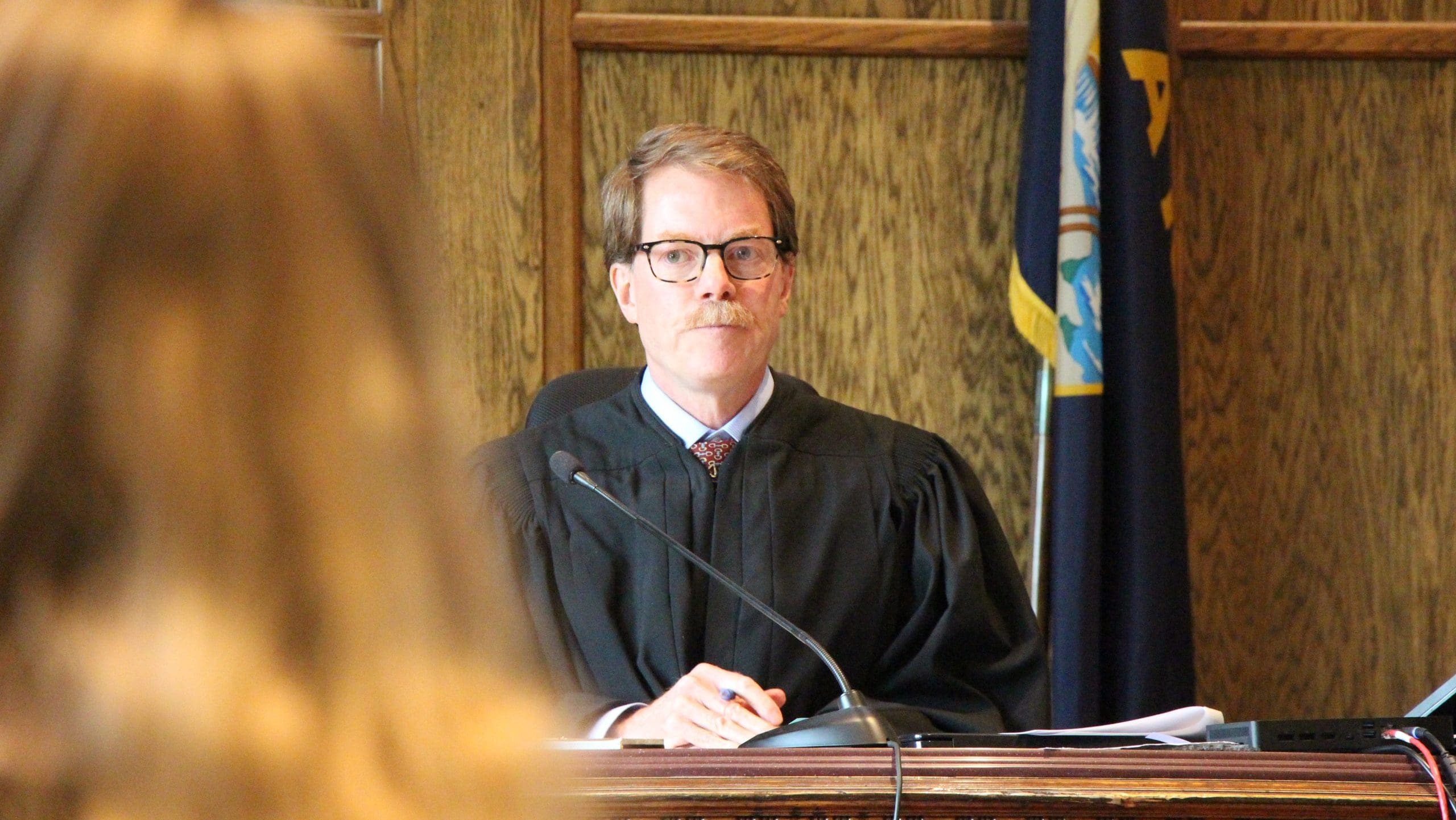
A state district court judge in Helena has temporarily barred the state from enforcing several policies that restrict how transgender Montanans can change their birth certificates and driver’s licenses.
The order issued Monday afternoon applies to three distinct laws, rules and policies recently created by state agencies and the Republican-controlled Legislature: A 2022 health department rule that bars changes to the sex listed on birth certificates based on gender identity, a Motor Vehicle Division policy that requires a person’s birth certificate in order to change their driver’s license, and parts of a sweeping 2023 law that creates strict definitions for “male” and “female” based on reproductive biology.
The ruling blocks the policies from taking effect while litigation in the case continues.
The plaintiffs bringing the lawsuit, represented by the ACLU of Montana, the American Civil Liberties Union and private law firm Nixon Peabody LLP, include two transgender women who say the state’s policies infringe on their constitutional rights of equal protection, privacy and free speech.
“Plaintiffs have met their burden of establishing likelihood of success on the merits under the preliminary injunction standard,” wrote Helena district court Jude Mike Menahan. The plaintiffs have also represented that the state’s actions appear to “violate their fundamental right to be free from discrimination on the basis of sex under the Montana Constitution,” Menahan continued.
The judge added that the state “did not suggest any state interest served by the challenged state actions,” but noted that those interests could be substantiated during later stages of litigation.
Spokespersons for the state health department and the Department of Justice, which includes the Motor Vehicle Division, did not respond to a request for comment about the ruling Tuesday morning.
In legal filings, lawyers representing the state departments have said the policies are not discriminatory against transgender people and simply enable accurate government record-keeping. The Department of Justice has also attested that its driver’s license policy has not changed.
More fundamentally, the state has argued that the lawsuit asks Montana’s courts to recognize transgender people as a protected class, a decision state lawyers maintain should be left to the Legislature.
“Plaintiffs’ claims present non-justiciable political questions that would effectively require the court to write a new protected class into Montana law,” the state wrote in a June legal filing. “Were the court to do so by creating the new protected class of subjective ‘gender identity’ — which is separate and distinct from sex — it would be invading the province of the Legislature and violating the separation of powers.”
The court’s ruling this week rejected that argument, reiterating the judiciary’s role as “final interpreters” of the Montana Constitution and its provisions.
“Determining whether a statute or state policy violates plaintiffs’ constitutional rights is directly in the jurisdiction of the court,” Menahan wrote.
The judge based most of the ruling on the grounds of equal protection. While he opted not to identify whether transgender people constitute a protected class, the court found the state policies could be analyzed under the category of sex-based discrimination, citing recent federal court interpretations regarding transgender rights.
“If the challenged state actions discriminate against transgender individuals on the basis of their transgender status, they also necessarily discriminate on the basis of sex,” Menahan wrote.
While the Montana Supreme Court has not said what level of legal scrutiny is triggered in such cases, the judge continued, the state Constitution’s Declaration of Rights directly protects individuals from sex-based discrimination. “Therefore, the right to be free from discrimination on the basis of sex is a fundamental right,” the ruling said.
That finding requires the state to prove a compelling interest in upholding the laws and policies as litigation continues, Menahan said.
In a statement celebrating the court’s decision, plaintiffs’ representatives predicted the case will continue at the district court level even if the state decides to appeal the temporary injunction to the Montana Supreme Court. The statement said that a trial in district court has not been scheduled.
The 2022 health department policy prohibiting gender identity-based changes to birth certificates is similar to a prior restriction drafted after a 2021 Republican-sponsored law required proof of gender-affirming surgery and a judge’s order before a person could update the sex on their birth certificate. Both the department rule and the law were eventually found unconstitutional.
Akilah Deernose, executive director of the ACLU of Montana, said in a Monday statement that the latest restrictions are the latest in a series of efforts by the state to marginalize transgender people.
“Here in Montana we treasure our right to privacy and to live our lives free from governmental intrusion. The state of Montana clearly has not learned any lessons from the past few years, where courts have repeatedly struck down unconstitutional laws targeting transgender Montanans,” Deernose said.
The law at issue in the case before Menahan, Senate Bill 458, was permanently enjoined earlier this year at the district court level in Missoula through a separate lawsuit. The state has not appealed that ruling to the Montana Supreme Court.
LATEST STORIES
How has ticket-splitting changed in Montana?
Voters selecting a presidential candidate from one party while choosing candidates from a different party further down their ballots have proven a powerful handicap for Democrats in tight political races, but that share of the electorate is thinning.
Fish and Wildlife Commission votes to reduce nonresident deer licenses
Montana’s Fish and Wildlife Commission on Dec. 4, 2025, adopted a handful of new deer hunting regulations aimed at reducing hunting pressure on public land and bringing the state’s flagging mule deer population out of a multiyear decline. During an eight-hour meeting in Helena, the commission voted to reduce available nonresident deer hunter licenses by about 2,500 licenses, cap the total number of deer a Montana hunter can kill in a season at three, and reined in the number of does both resident and nonresident hunters can…
British man, in Great Falls for 11 years, fighting ICE removal in federal court while fiancée expecting child
A federal judge has barred ICE from transferring the man, 26-year-old Dakota Wheeler, out of Montana, at least temporarily. The immigration agency is challenging the order.