


Sign up for the free Great Falls This Week newsletter and stay in the loop on Great Falls city government, public school meetings, business news and upcoming entertainment and events.
9/14/2025
Reeves talks about the library decision, struggling funds and more
On Nov. 4, voters in Great Falls will choose between two mayoral candidates: Incumbent Cory Reeves and challenger Jasmine Taylor. Montana Free Press interviewed both candidates about their platforms and plans for office. Reeves’ interview is below, and Taylor’s will be in next week’s edition of Great Falls This Week.
Reeves is the coordinator for the RESTART youth program through Great Falls Public Schools and a former police officer. He was first elected mayor in 2023.
This conversation was edited for clarity and length.
MTFP: The city raised utility rates this year to support the infrastructure to grow the city, and there’s an ongoing discussion about how the city should incentivize developments. Where is the line between attracting builders and giving away too much?
Reeves: That was probably one of the hardest decisions I’ve made in my tenure as mayor, raising utility fees. I pay those fees. My elderly parents, on a fixed income, pay those fees. I get it. It was something that needed to be done, though. So what we looked at was a lot of our sister cities that have additional infrastructure funds to pay for developments, and everyone is always telling us we need growth in this community. We want developments, but we have no capital. We have no money. We have tax abatements and TIF [tax increment financing] funds to incentivize. So, when Public Works Director Chris Gaub told us that they have over $200 million in infrastructure needs, whether that’s upgrading the water lines, the sewer, the roadways, etc. We don’t have enough for it. So, that is the big reason why I supported this increase, because it’ll give us a total of $6 million, ballpark — $2 million for roads, $2 million for a sewer, $2 million for water lines to upgrade.
It’s my understanding, and nothing has been solidified yet, but what’s going to happen is it’ll be similar to a TIF. So not all of that $6 million will be used for you, the developer, who comes in and says, ‘I need $6 million,’ because we would deplete it every single time.
It’s my understanding that city staff is still working behind the scenes on a policy of how much of those allotted dollars will we use to help create a new development or new neighborhood and how much will go to support our existing infrastructure because we have a very aging infrastructure in Great Falls, Montana.
MTFP: There was that big discussion in the last work session that [City Manager Greg Doyon] gave. Do you think there’s room for more structures of incentives and things like that for the city to offer up?
Reeves: I don’t know if there’s more incentives as of right now, so I think, like I said, we talked about tax abatements. We talked about TIFs. We talk about the increase in utility fees to help for infrastructure. We’re also looking at doing like a soil exemption. Because Great Falls soil sucks. It just does, and everyone knows that. And every time we approve a project, but then your house, so your building settles, we’re on the hook.
We, as the taxpayers, right? We get sued, saying, ‘You let us build on crappy soil.’ So we’re working right now behind the scenes, which will be coming forward to the community soon on a soil exemption that we know that in certain pockets of the community, their soil is okay, you’re gonna have to sign off on it as a developer saying, ‘If something does go wrong, you’re not going to turn around and sue the city of Great Falls because we’re allowing you to build in this area.’
MTFP: The commission voted to reallocate funding from the Great Falls Public Library last year after months of negotiations. With about a year of hindsight, how do you feel about that decision and would you vote the same?
It wasn’t fun. Yes, my decision would be the same. This community was torn on that topic. I think this community is still torn on this topic. We renegotiated a management agreement, and that is commonly done, just like we do with [golf course operator] CourseCo. Just like we do with all of our vendors in the community. I get it. This one hadn’t been touched for 30 years, for a long time. But I also knew that I had the fire department that has absolutely no training facility.
If someone was tearing down a building, they would let us go in and the firemen practice on that before they finish demolishing it. You know what I mean? But otherwise, their fire training center out there has been condemned for many years.
We’re telling you to be proficient and to go out and fight fires, but we don’t have anything to train you on. It’d be like saying to the police officer, ‘You need to be proficient with your duty weapon, but we don’t have a gun range for you to practice on.’
It just makes no sense to me, and so no, it wasn’t a tough call. And I feel I did something very courageous. We were looking to come after all seven mills, and a group of supporters of the library came forward and let their voices be heard, so I knew we had to revisit this.
I also talked to Susie McIntyre, the director, and she said, ‘Cory, if you guys do take all seven mills, we will have to go back on some of the things we promised the community from the actual levy. So I asked Susie: If we were to take 3.5 mills, would you still be able to function at the level that you promised the community at the level that you promised when you asked for this levy? And she said we would.
What that 3.5 mills turned around and let us do was now invest in the new fire training center, which I think is very important. Being in leadership, being the guy who has to make budget decisions. Not just me, but for all, the commissioners is not easy, and it’s not fun because everyone has their pride and joy, if you will, and what they think is very special to them.
And I’m a library user. I go to the library all the time with my RESTART kids. They see me there all the time. We work on resumes and job applications, so I understand the importance of the library, but I also understand the importance of having proper public safety and facilities to do their jobs.
MTFP: Public Safety in Great Falls has many more needs than those 3.5 mills. How should the city approach funding public safety departments?
I don’t know. That’s a great question, and one we wrestle with to this day.
Unfortunately, and this is my opinion, but I don’t like the way the state of Montana does our tax stuff. It relies solely on you and me. It relies on our property taxes, and we can only come after so much of people’s money, and they’re going, ‘Stop. Enough’s enough,’ which I get.
One of the things we’re talking about is that we may have to go back to the community with another safety levy and bond, unless the state legislators really shift the way the taxes work at the state level.
But I also know if we were to put that before the community right now, they’d say, ‘Get bent. We’re not doing it.’ So I don’t know. The police and fire departments, even legal, the courts, are making do.
If someone has a magic bullet for us, I would love to know what it is so we can make this happen. Me personally, I would like to see us eliminate a tax in the state of Montana. So, eliminate an income tax or something and implement a sales tax. But my fear is, they would never eliminate a tax to add another. They’ll just add another tax, and that I will never support. And I think our community, the state, wouldn’t support.
MTFP: In an attempt to balance general fund resources, the city is taking a close look at struggling funds like outdoor pools, the multisports complex and the Civic Center. How would you approach the difficult decisions that could reduce revenue in one department to help another?
We just hired a company, TheatreDNA Dna, to come in and do an analysis to see.
I believe in a very limited government, so I would like to see those things privatized, just like we did the golf courses. I don’t personally think the government belongs in those types of things. I believe we’re here for proper water, roads, public safety, you know, the core functions of government. It’s just my opinion, but I think we’ve spread too much into these other fields.
We have a Newberry that holds awesome concerts and stuff. So why do we need to have a convention center and try and compete with the Newberry and places like that? I don’t think we need to.
And they’re a drain, especially the swimming pools. They’re a drain to the tune of about $8,00 to $10,000 a month on the general fund. That money can be going towards public safety, a core function of the government, in my opinion. So I’m all for these studies that we’re having to see what we can do differently.
Yes, there’s an understanding that government provides recreational opportunities, and I fully support that. I think our parks are important. Do I think we need 57 parks in the city of Great Falls? I don’t. That costs money to upkeep them with mowing and watering and stuff. Some of them, people wouldn’t know they’re a city park, but they’re designated as a park, and we have to maintain them.
I’m not going to get into the swimming pool thing, the Scheels Aim High, because that was before I was ever in office. But personally, I would have done things differently a little. I think, although the intent was awesome and it was a great partnership with our military partners, I don’t think we properly forecasted the costs of running that thing, and now we’re in the spot that we’re in.
MTFP: If I may add a point of clarification. You mentioned privatizing some of these departments. The golf course, I would say, is more of a public-private partnership.
Reeves: Yeah, OK, so that is very accurate. That’s exactly what I’m talking about. Yes, so someone to come in to run the golf courses.
Just like CourseCo runs our golf courses, it’s a public-private partnership. I would like to see someone come in and see if they could run our Mansfield Convention Center and the multisports complex and swimming pools and like that. Not to sell it off.
MTFP: There’s buzz around town about growth with the Air Force Sentinel project, various proposed developments and the growth of Montana Renewables. What do you think is in store for Great Falls in the near future and what can the city’s mayor do to have success?
OK, so I ran in ’23 that I wanted to see growth in our community, but reasonable growth. Because if we become Bozeman or Kalispell, we will outpace our public safety, our infrastructure. We will not be able to afford our homes. So I am all for reasonable growth, and I think that is what we are seeing in our community.
We’re not exploding, and I hope we don’t explode with population. But we are seeing more people interested in developing here in Great Falls. I think anyone can drive down 10th Avenue South and see the development that’s going on. All that development is wonderful, but where I think we’re still lacking in our community is we need to start attracting more light industrial businesses.
It’s your light industrial that really brings money to the coffers, to the general fund. So I think we need to continue with our partnerships with Great Falls Development Alliance, Homebuilders Association, Great Falls Chamber.
It’s got to be a collaborative effort of all of us working and moving in the same direction to bring reasonable growth to our community. And I truly believe in the last two years, we’ve really buttoned up our partnerships and relationships where I think it’s very good. Everyone is truly working together, and I’m very proud of that.
Like I said, going full circle when we talk about growth. That is why we had to raise utility rates, because we were trying to anticipate that these things are on the horizon. They’re coming this way. So let’s have a little money set aside now, so we can invest when the Investments are needed.
I think we need to just be smart about the money that we do get from the citizens. I’m a fiscal conservative, I think all of your city commissioners are very fiscally conservative, and I’ve gone through that [budget] fine tooth and nail, and I don’t see any pork or wasted stuff that we do.
There’s always areas we can improve a little, and we’re trying to work on those things. But overall, I think we run a solid budget. We have very capable accountants and a city manager who is very cognizant and aware that we get a lot of money from the community, and we need to spend that wisely.
So I think that if we continue on that path, we’ll be OK. I’m personally very excited to see what happens over the next two to four years in Great Falls. I think it’s going to be fun. We got people who are excited about investing in Great Falls.
I want to touch on housing. That is probably the No. 1 issue we’re facing in Great Falls is affordable housing. We have approved every housing development that’s come before us. We’ve never said no. I respect and understand some people have the not-in-my-backyard mentality, but we’re trying to move past that and say everyone gets to be part of this.
There’s been senior housing living. There’s been affordable, low-income, moderate-to-low-income housing. There’s been upper-scale housing developments we’ve approved. So I think we’re trying to approve what the community’s needs are, which is a whole spectrum of different types of housing.
Photo op
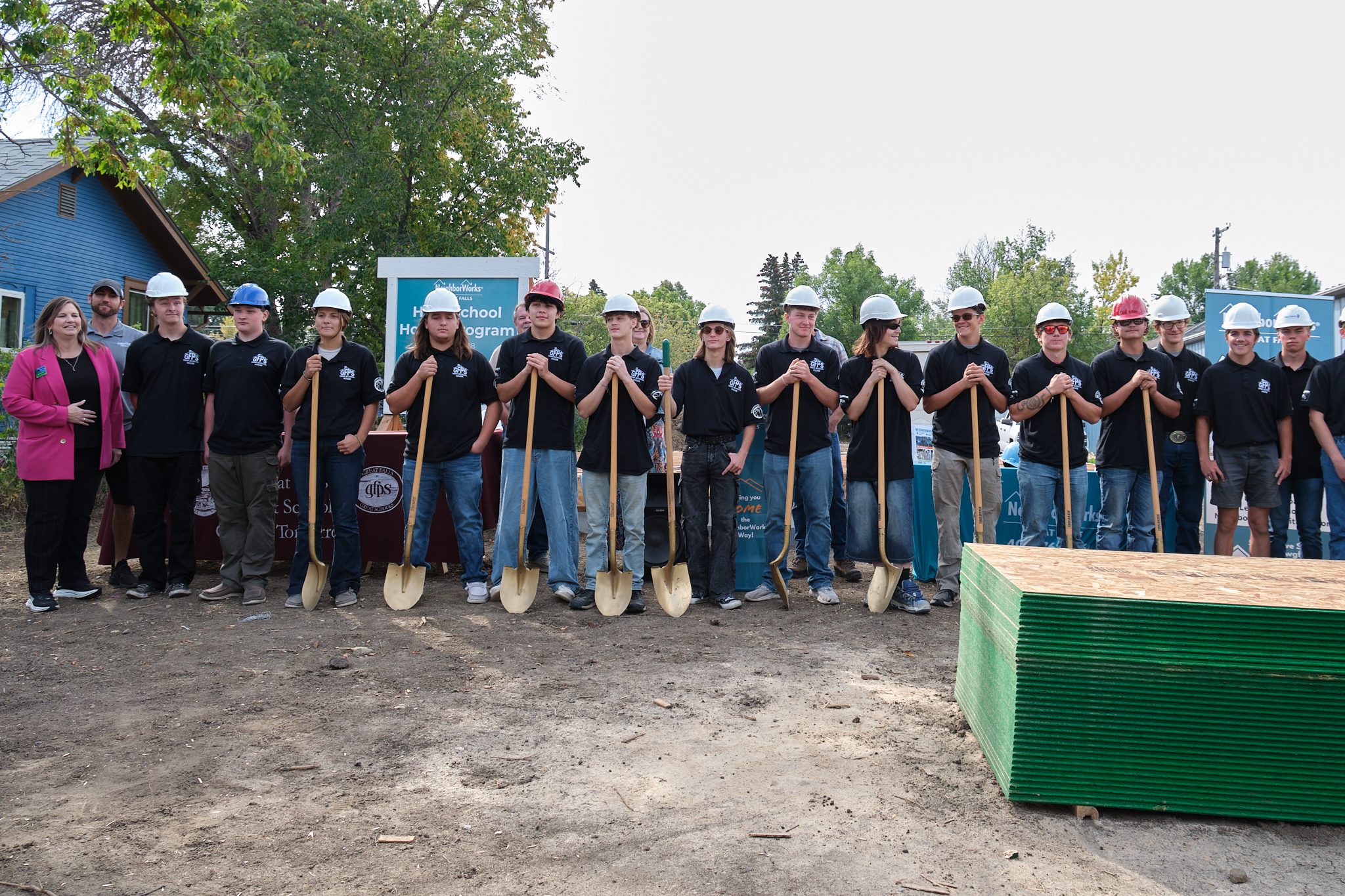
Students broke ground on the 48th High School House Sept. 11. This marked the beginning of work for the 48th house in the student program, which has been in place since 1997. For each home, students work as part of a specialized shop class to construct an affordable house that’s later sold to a community member. During the groundbreaking, Great Falls Public Schools Superintendent Heather Hoyer and NeighborWorks Great Falls Executive Director Sherrie Arey stressed that this project is possible due to an array of community donors, including the real estate, construction materials, professional services and others.
Calling all photographers: Submit a photo for Great Falls This Week to mhudson@montanafreepress.org.
5 things to know in Great Falls
Cascade County commissioners accepted what could be the first of a series of grants from the Department of Defense to help handle the impact of the Sentinel missile upgrade project. Sept. 9, commissioners accepted a $179,949 grant that will fund a temporary, full-time county employee who will oversee the county’s efforts as a liaison between the defense department and missile field communities. In a press release, commissioners said that the county will manage the grant operations but work with communities across Montana impacted by ICBM operations. The Sentinel missile project is a $140 billion endeavor to swap out the Minuteman III nuclear missile for a newer model.
Cascade County commissioners approved a measure to move the Department of Emergency Services under the sheriff’s office. The move is an attempt to streamline operations between the two departments, which often work together. DES has seen a drop in federal and state grant funding that supports its operations.
Great Falls Park and Recreation has launched a scavenger hunt along River’s Edge Trail. The event encourages participants to take a selfie with five different sculptures along the trail in creative ways. Submit your entries to parkrequests@greatfallsmt.net by Oct. 31 to receive a prize. A sculpture list and map are available online.
Montana Air National Guard had a change of command on Sept. 7 as Brig. Gen. Trace Thomas assumed command at the 120th Airlift Wing in Great Falls. He succeeded Brig. Gen. Buel Dickson, who retired after 38 years, according to a press release. In addition to leading the 120th Airlift Wing, Thomas also manages the 219th Redhorse Squadron and Joint Force Headquarters-Air in Helena.
Cascade County commissioners will hold a special public hearing Sept. 15 on potential increases to commercial solid waste fees. The proposed changes to commercial fees come after the county implemented a 45% fee increase across the board last year. At that time, county staff described the fee structure as outdated and inconsistent. Commercial fees are assessed by the type of property, and some proposed increases are significant. A property with a house and five motel units will get a fee increase from $346.55 to $2,080, for example. All proposed increases can be found here, and the hearing is 10:30 a.m. at the county commission chambers.
Public notice
The Great Falls City Commission will consider setting a public hearing to spend downtown tax increment financing funds to help with the Mansfield Theater ceiling, seating and elevator renovations. Earlier this year, city staff sought private donations for an anticipated budget shortfall in the renovation project. The funding gap appears to be $398,690 currently, according to city commission documents. The project already received $400,000 from the TIF fund.
Initial cost estimates for the project were $1.2 million, but bids totaled $1.6 million.
The commission action at its Sept. 16 meeting won’t make a final decision on the TIF funds but will set up a public hearing for Oct. 7.
The commission will also consider approving the stormwater master plan, which hasn’t been updated in three decades. The plan proposed and prioritized improvements to the city’s system. Read more about that plan here. The full master plan can be found here.