


Sign up for the free Missoula This Week newsletter and stay in the loop on Missoula city government, public school meetings, business news and upcoming entertainment and events.
11/21/2025
“Missoula This Week” is reported and written By Katie Fairbanks. Send your Missoula news and tips to kfairbanks@montanafreepress.org.
Coordination, flexible funds helped house more than 60 people, city staff said
City staff this week presented the final numbers for the “housing sprint” tied to the closure of the Johnson Street homeless shelter earlier this fall and outlined the city’s strategies going forward.
Officials also highlighted the benefits of flexible funding available during the sprint to pay for a variety of housing-related costs or debts that often prevent people from securing housing.
“The housing sprint really demonstrated to us the value of flexible funding that’s targeted for people who are literally unhoused and what can happen when those funds are really targeted appropriately,” Emily Armstrong, the city’s houseless programs manager, told the city council Wednesday.
The city closed the Johnson Street shelter Sept. 2 after a five-month phased closure and the sprint effort to house as many residents as possible.
More than 250 people engaged in the housing sprint, and 63 people secured permanent housing, up from the 60 the city reported in early September. Of those, 58 were staying at the Johnson Street shelter and 44 received housing sprint funds. People staying at the shelter between January and March were eligible for the funds raised by the city and administered by the United Way of Missoula County. The majority of those housed through the sprint, 37 people, moved into a rental with no ongoing housing subsidy.
“It’s really important to note that, yes, many people need some sort of resource or support to find housing, but there’s a lot of people in our community who are able to sustain housing on their own and could just benefit from some additional light-touch case management, maybe one-time financial gap funding,” Armstrong said.
Another 12 people received a housing subsidy, 10 moved in with family or friends permanently, two moved into long-term care or nursing homes and two moved into group living or transitional housing. Five people moved into temporary housing, with four accessing substance use treatment and one living with friends.
As of Thursday, 57 of the 63 people permanently housed through the sprint remain housed, Armstrong told Montana Free Press.
Approximately $180,850 in housing sprint funds was spent to help 133 individuals, primarily with rental or deposit assistance, application fees, home furnishings and cellphones, Armstrong said. The city is using the $20,000 remaining at the end of the sprint to provide housing retention support for individuals who were housed during the sprint, she said. That could include helping with a rent payment if someone has an unexpected medical bill or paying for cleaning supplies needed to maintain their apartment, Armstrong said.
Throughout the sprint, city staff hosted 40 “office hours” at the shelter twice a week, during which staff and volunteers completed 788 housing problem-solving conversations. People were mostly seeking assistance with housing, income, documentation and case management, Armstrong said.
Along with the city, more than a dozen organizations participated in the “office hours” at the shelter, including the Housing Advocate Network, Crosswinds Recovery and the Missoula Housing Authority. The Missoula Food Bank and Community Center helped people fill out applications for food assistance and Medicaid, Armstrong said. Job Service Missoula helped people at the shelter make resumes, search for and apply for jobs, she said.
Armstrong said staff from a variety of participating organizations indicated during an October meeting that the sprint’s flexibility, coordination, resources and onsite location worked well.
However, the sprint was a “really hard project” with limited time to plan before it began, Armstrong said. While long for a sprint, the limited timeframe was also challenging, particularly for addressing complex problems and moving through an often time-consuming process, she said. The effort also highlighted the lack of housing options for people on fixed incomes of $800 to $1,100, Armstrong said.
The city department is working to integrate the housing problem-solving questionnaire used during the sprint into the coordinated entry system to gather baseline information, Armstrong said. Staff is also tweaking a document outlining next steps for housing problem-solving to be distributed to community organizations, she said. In January, the city will launch a landlord engagement pilot to foster relationships with landlords and support new tenants.
Next year, the city will launch its new Pathways to Housing Stability program funded by an opioid abatement grant to help people maintain their housing, Armstrong said.
The city is also working with the Poverello Center, Missoula Interfaith Collaborative and churches to create emergency weather overflow spaces, Armstrong said.
Housing Advocate Network volunteer Annie Sondag said it’s “amazing” that about a third of the people staying at the Johnson Street shelter when the closure was announced found housing, but thinking about the other two-thirds keeps her up at night.
“Affordable housing is a good thing to focus on, but we really need some conversations around who is going to be sleeping outside,” she said.
Public Notice
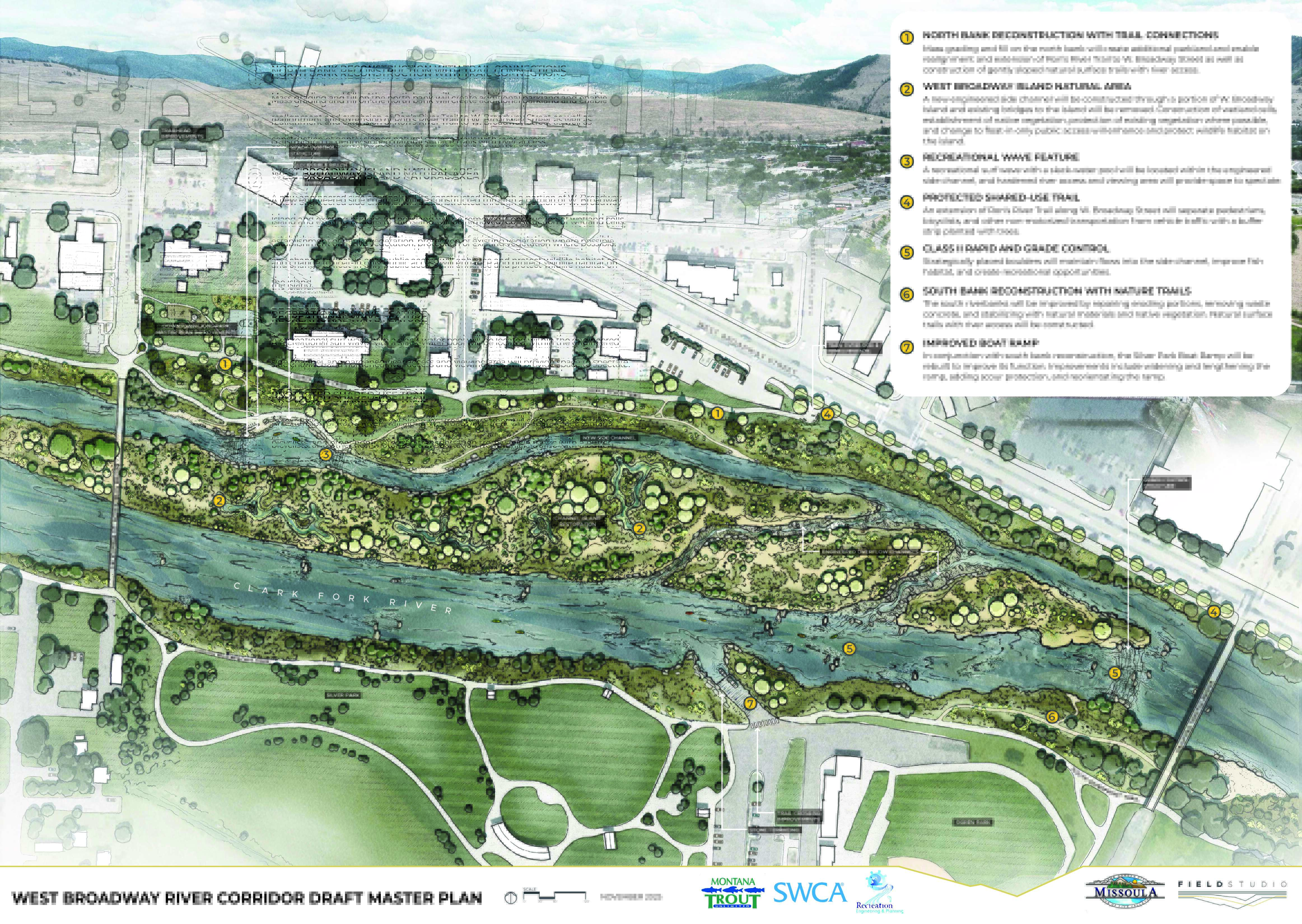
The city is asking for feedback on a new draft West Broadway River Corridor Master Plan that includes river restoration, improved river access points, debris removal, irrigation ditch removal and improvements to trails and recreation opportunities for the area along the Clark Fork River between the Montana Rail Link railroad bridge and the California Street pedestrian bridge. The city is partnering with Montana Fish, Wildlife and Parks and Trout Unlimited on the project.
“The West Broadway River Corridor project provides a unique opportunity for our community to reenvision a major section of the Clark Fork River through downtown Missoula,” said Morgan Valliant, associate director of the city’s ecosystem services division, in a press release. “The draft masterplan depicts new parkland, important trail connections, enhanced river recreation, and improved wildlife habitat. It’s an exciting project with profound possibilities.”
The plan outlines the city’s vision for the area, informed by a 2023 public survey, and includes:
- Filling in the Flynn Lowney Ditch north of West Broadway Island and removing the irrigation headgate structure
- Creating a new side channel with a recreational wave feature
- West Broadway Island habitat improvement and removing bridges to limit access
- Reconstructing the Silver Park boat ramp
- Removing concrete and metal debris from the river and riverbanks
- Constructing a Class II rapid to create grade control and divert flow into the side channel
- Trail improvements and new river access points
- Riverbank stabilization, restoration and vegetation
The plan also explores the feasibility of the project, anticipated maintenance and cost estimates. The total project estimate is $7.2 million and will be refined at each stage of engineering design, according to the plan. Following the adoption of the final plan in early 2026, the city and its partners will apply for grants and raise money for the project, with construction slated for summer 2028, dependent on funding.
“This is a big, complex project,” Valliant said. “Development of the draft master plan occurred with support from the Missoula Redevelopment Agency and extensive input from state and local departments, non-profits, and the public. As we move from planning to project implementation, it will be essential to maintain these high levels of collaboration within the community.”
The draft plan and project concept drawings are available online, along with a survey about the project open through Dec. 14.
5 Things to Know in Missoula
The Missoula City Council Monday approved a developer’s request to push back deadlines for the Aspire Subdivision in East Missoula by three years to allow a lawsuit over the development to conclude. The first phase is due Dec. 31, 2028, with the five subsequent phases due every two years. In August 2024, the council annexed the 35-acre property, rezoned it to include a neighborhood character overlay and approved the preliminary plan for the 250-unit subdivision, located adjacent to the Clark Fork River and Interstate 90. The following month, an East Missoula landowner sued the city seeking to overturn or further review the project. Several East Missoula residents voiced concerns about the development’s effects on traffic safety, the loss of a $24 million federal grant to improve Highway 200 and other new residential developments in the area. The council, in a 10-1 vote, approved the new deadlines as well as an updated condition that requires future subdivision residents to waive their right to petition a special improvement district to raise money for Highway 200 improvements.
On Wednesday, the Missoula City Council approved the 2026 budget for the Local Government Building Special District, including about $4.3 million for three capital projects. The city and Missoula County split the costs for the John Engen building, formerly the federal building. The U.S. Postal Service leases part of the building, and that $149,000 annual rent covers about half of the $294,000 annual operating budget, said John Adams, the city’s strategic projects manager. The capital projects planned for 2026 include $2.75 million for hazardous materials abatement, partially funded by a $1.9 million Brownfields Revolving Loan Fund grant, and a $857,000 State-Local Infrastructure Partnership Act grant. Work will also begin on updating the northwest entrance to be ADA compliant, which will cost about $624,000, with $350,000 covered by a state grant. The city and county plan to spend about $927,000 to design “backbone” improvements, including roof repair, structural upgrades, main lobby renovations, a security system, stair repairs, new data infrastructure, lighting and mechanical and plumbing upgrades. The preliminary cost estimate for all that work is about $12.8 million, according to the special district budget. The city council and county commission will vote before that construction begins.
The Missoula City Council Monday rezoned a property on Reserve Street to make way for a new Les Schwab Tires location. Representatives of the company requested the rezoning of 1010, 1020 and 1030 Reserve St., between Eighth Street West and Ninth Street West, from business mixed-use to community commercial. The change would allow for more “intensive” uses and density, according to the staff report. The new zoning code the city is set to adopt at the end of the year would allow for similar types of development in the area, said John Sand, a city associate planner. Council Member Kristen Jordan raised concerns about the decreased quality of life for neighbors due to noise and unsuccessfully moved to send the request back to committee review to discuss the problems of commercial areas abutting residential neighborhoods. City Attorney Ryan Sudbury acknowledged the difficulty of enforcing the city’s noise ordinance and said his office is looking into potential fixes. An area resident raised concerns about traffic turning off and on Reserve Street to access the business. Sand said a traffic study will be completed as part of the building permit process, and the Reserve Street safety plan currently in the works will also recommend changes to the corridor. The council approved the zoning change in a 10-1 vote, with Jordan opposed.
The Missoula County commissioners Thursday approved an application for a state grant to fund a new county septic replacement program. The $500,000 state Community Development Block Grant would help low- to moderate-income homeowners outside city limits replace failing septic systems. If a homeowner receives a grant, a five-year deed restriction will be placed on their home, requiring them to pay back the money if they sell their home or no longer use it as their primary residence during that timeframe. Owner-occupied, single-family homes with households earning 80% of the area median income would be eligible. The county expects to assist four homes a year with an average replacement cost of $35,000 to $45,000, said Kayla Talbert, a county grants administrator, during the commissioners’ Nov. 13 meeting. The county would launch the program in summer 2026 if awarded the state grant.
The Salish Kootenai Housing Authority’s ʾIt̓qaʾwxam Nk̓ʷúwilš Solidarity Program is hosting a panel discussion about housing on the Flathead Reservation Friday in Missoula. Kaia Peterson, executive director of NeighborWorks Montana, will moderate the “Healing Through Housing” panel, which includes Jody Cahoon Perez, housing authority executive director, Steven Morigeau, with NARSS Recovery Village, Dana Hewankorn, CSKT food sovereignty program manager, and Nora Mabie, MTFP’s Indigenous Affairs reporter. The event is free, but attendees are asked to RSVP online. The panel begins at 7 p.m. at 1500 Burns St.
Thanksgiving goings on
The Missoula Food Bank and Community Center is distributing turkeys and other dinner supplies to those in need of a holiday meal from 9 a.m. to 6 p.m. Sunday at 1720 Wyoming St. The drive-thru line moves east to west on Wyoming Street, and cars should enter from Russell Street. Walk-up customers are also welcome. Volunteers will direct traffic.
Veterans, service members and their families are invited to a free Vetsgiving dinner at American Legion Post 27 on Tuesday. The Veteran Support Network and the Missoula Housing Authority are hosting a dinner, featuring turkey, ham, and all the fixings, from 4 p.m. to 7 p.m. at 825 Ronan St.
The Western Montana Community Center is holding its annual Queergiving dinner from 11 a.m. to 2 p.m. Thursday at the Burns Street Center. Volunteers to help with meal preparation, setup, cleanup and provide side dishes can sign up online.
Those looking to stretch their legs before dinner can now register for Run Wild Missoula’s Turkey Day 8k and 3k Family Fun Run. The races’ courses both begin at 9:30 a.m. at the University of Montana on Campus Drive across from the recreation center near Washington Grizzly Stadium. The races are open to strollers and walkers but not dogs. Those interested can register online. The 3k run is free, but registration is required. The 8k costs $44 for runners 20 and older and $20 for participants 19 and younger. All participants are encouraged to donate non-perishable food or money to the Missoula Food Bank. For every pound of food donated as part of the run, Run Wild Missoula and Young Mazda Missoula will match with a donation of $1, up to $1,500.
Might be Fun
The Zootown Music Festival is returning for a second year, and tickets go on pre-sale at 10 a.m. and general sale at 1 p.m. Friday on the event’s website. Discounted locals-only tickets will be available at Rockin Rudy’s starting at 10 a.m. Friday. The festival, set for Friday, June 19, and Saturday, June 20, will take place at the Missoula County Fairgrounds. The event will feature a lineup of 23 musical artists, including The Lumineers, The Chicks, Rainbow Kitten Surprise, The Head and the Heart, Tedeschi Trucks Band and Trampled by Turtles.