


BILLINGS — A pitch to build a new state psychiatric facility in Montana’s largest city, floated by the administration of Gov. Greg Gianforte but previously criticized by Billings officials, may not be entirely dead yet.
After a political fracas broke out this summer between local elected officials and Gov. Greg Gianforte’s administration, the project appeared to have stalled. In recent weeks, though, Billings-area mental health advocates and legislators have formed a working group aimed at salvaging the community buy-in necessary for the new institution to move forward.
Their message to the Gianforte administration — which is asking local leaders in eastern Montana to volunteer their communities as a site for a state-run, 32-bed facility to treat mental health patients who have been charged with crimes — is not without caveats. Some group members still worry about workforce capacity and straining community services.
But many of the working group members who gathered in a community meeting space on Billings’ southside Tuesday morning articulated a clear message for state officials in Helena: Don’t give up on Billings quite yet.
“We’re not going to stop. The momentum is going, the train has left the station, and we are going to make this happen,” said Sen. Mike Yakawich, a Republican lawmaker and former Billings city councilmember who helped organize the group.
Jon Forte, the director of local health department RiverStone Health, echoed the sentiment.
“One of the things that we’re doing is proving to the state, proving to the Gianforte administration, Billings actually does have its shit together. And we can collaborate and work together to get things done,” Forte said.
A report released Monday by the state Department of Public Health and Human Services indicates the need for a forensic facility in the eastern half of the state is dire.
The department, which runs the Montana State Hospital in Warm Springs, acknowledged that the western Montana facility has struggled to assess and treat criminal defendants with severe mental health issues. The state’s waitlist for those services has stretched to as many as 130 people at a time over the last two years. Many of the people on the list are held in county jails while awaiting treatment.
“County jails are increasingly housing individuals who require psychiatric care, not incarceration,” the department wrote. “These facilities are not equipped to provide appropriate treatment, leading to worsening symptoms, increased risk of self-harm, and potential violations of constitutional rights.”
The department also said that limited availability of forensic beds for criminal defendants is forcing courts to dismiss charges and allow criminal defendants to be released without treatment, “contributing to a cycle of relapse, homelessness, and recidivism.”
A state facilities bill passed by legislators earlier this year directs the state health department and the Board of Investments to create a mental health facility to address that need. Lawmakers allocated $26.5 million for the project.
In its report, the health department said that adding 32 forensic beds in eastern Montana would represent a 60% increase in the state’s capacity, which is currently concentrated on the Warm Springs campus, about thirty minutes northwest of Butte. It also said having beds in eastern Montana would reduce how often law enforcement officials have to make long drives to transport patients for psychiatric evaluations and treatment.
The report also stressed that the facility would need to be able to expand in the future or adjust its operations to serve mental health patients who aren’t routed to it through the criminal justice system.
“With the new facility, DPHHS will be better positioned to provide state psychiatric services regardless of what type of capacity (forensic or civil) is most strained in future years,” the department wrote.
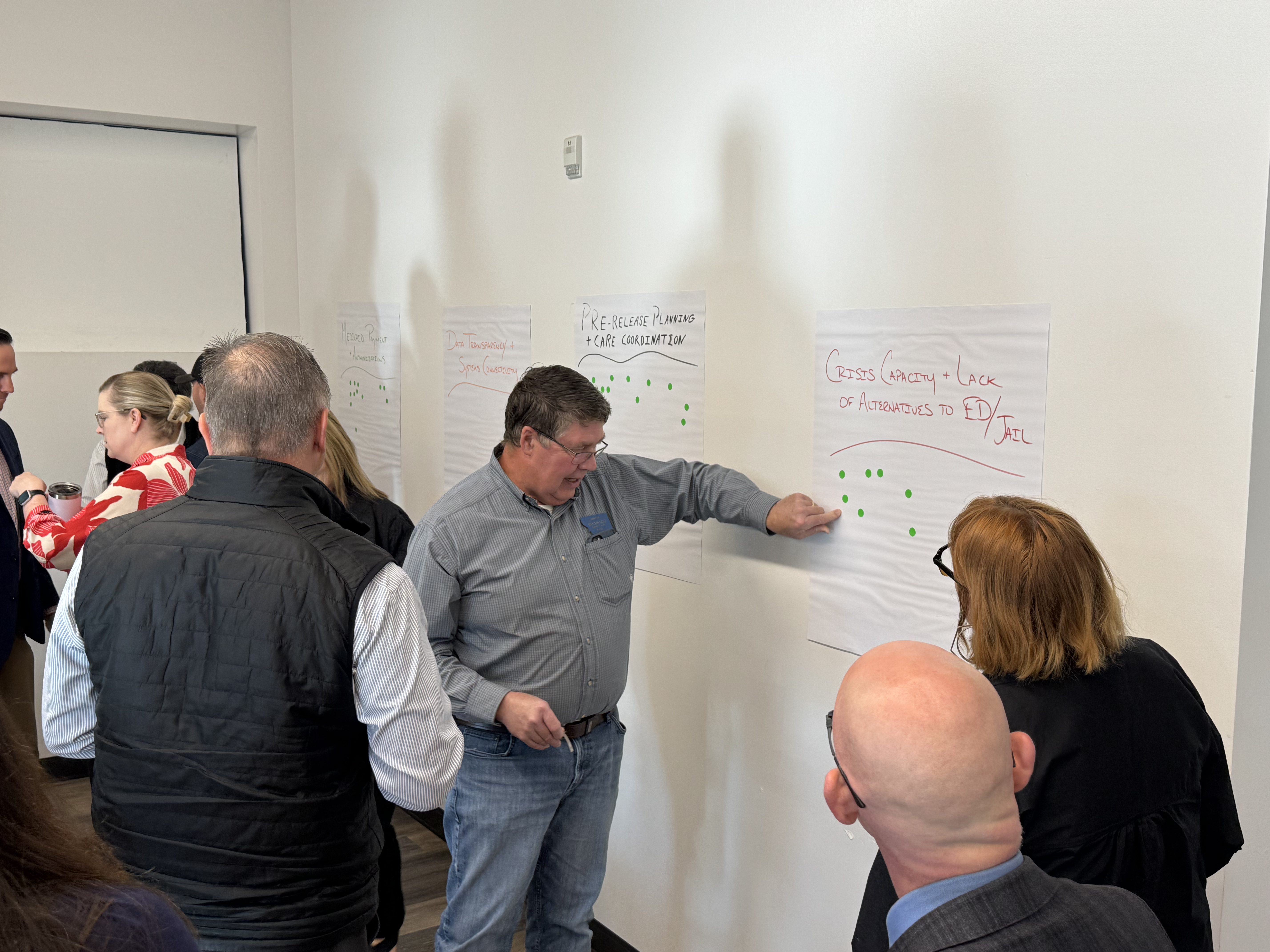
During the Tuesday morning meeting, attendees put colored sticky notes on white boards and huddled their heads together to discuss how the facility could impact them.
The group — made up of representatives from RiverStone Health, Billings Clinic, Intermountain Health St. Vincent Regional Hospital, local mental health clinics and addiction treatment centers — has dubbed itself the Behavioral Health Facility Community Working Group. Spurred on by Yakawich and other lawmakers who have long pushed for more mental health services, the group began gathering in September to deliberate about whether they’d welcome the psychiatric treatment center on their home turf.
On Tuesday, members picked apart some of the biggest issues at the root of their opposition: Communication breakdowns as patients are transferred between health providers, long-term funding issues, and a limited pool of qualified mental health workers.
“You bring a facility that’s gonna need 450 [employees], right, we’re probably going to lose 25-30 [staff],” said Jeffrey Keller, the CEO of Billings Rimrock Foundation, a substance use treatment provider. “So how do we keep those people?”
Despite the complexity of the problems discussed Tuesday, many participants said they were committed to trying to find solutions.
Yakawich and others said the meeting’s goal was to keep people focused on how to fill gaps, not put up more barriers to the state’s proposal. He and other lawmakers pledged to take the group’s notes to the state health department to try to find long-term solutions, through policy changes or new laws drafted when the Legislature meets again in 2027.
Despite Tuesday’s discussion, some supporters of the facility worry that lingering opposition might make Billings miss the chance to compete for the state facility. Officials in Hardin, 45 minutes east of Billings, as well as Laurel and Columbus neighboring it to the west, have expressed interest in hosting the state’s operation — and the jobs that come with it.
Sen. Dennis Lenz, R-Billings, another supporter of an eastern Montana forensic facility, said in a Monday phone interview that he began “laughing my head off” when he saw local news segments about officials in other towns vying for the facility after some Billings council members and county commissioners seemed to snub it.
“We [ran] into the Negative Nellies,” Lenz said, chuckling. “Politicians going ‘No, I don’t want any jobs!’ That just startled me.”
Lenz pointed out that putting the facility in a nearby town wouldn’t take it outside Billings’ orbit. The population center would still provide the largest pool of health care workers. The city’s services would still be tapped by people eventually discharged from the facility. And the Yellowstone County Detention Center would still benefit from having a better place for people to go for treatment.
Ultimately, Lenz said, he said he’s hopeful that community leaders somewhere in eastern Montana will seize the opportunity, rather than being resistant to change.
“This is going to happen,” he said.
LATEST STORIES
You can still get a ticket to Cat-Griz 2.0 — but it’ll cost a paw and a tail
Tickets for the first-ever playoff matchup between the University of Montana Grizzlies and the Montana State University Bobcats Dec. 20 hover between $400 and $3,700, riling up some fans who decry MSU’s decision to sell seats to season ticket holders instead of the general public.
After brother’s suicide, Blackfeet sisters are creating a horse-based alternative to talk therapy
Wyatt Mad Plume took his own life two years at age 29. Ever since, Wyatt’s sisters Lynn and Erika have been trying to turn their grief into something concrete and purposeful. Specifically, they want to provide free mental health resources to community members in the company of horses, animals their brother loved. Local men in particular, Lynn and Erika say, tend to resist talk therapy. They hope an alternative, informed by a blend of emerging mental health research and longstanding cultural traditions, might help reduce the likelihood of a death like their brother’s. They’re eager to make a dent in…
Helena’s next city manager is Alana Lake
In a 3-2 decision, the Helena City Commission appointed Alana Lake as the next city manager. Outgoing Mayor Wilmot Collins, Commissioner Sean Logan and Mayor-elect Emily Dean voted in support of Lake’s appointment. Commissioners Andy Shirtliff and Melinda Reed voted in opposition.